
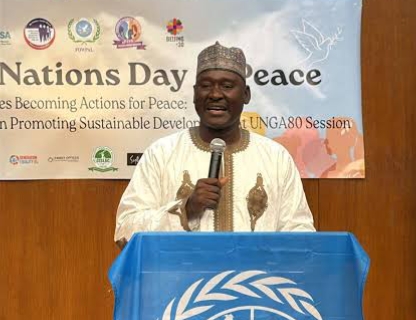
The Corporate Accountability and Public Participation Africa (CAPPA) has announced the appointment of Auwal Musa Rafsanjani, one of Nigeria’s foremost civil society leaders, as the new Chairman of its Advisory Board. The appointment followed a board election held over the weekend and signals what the organisation describes as a renewed mandate to defend people, public resources, and democratic space across Africa.
In a statement signed by Akinbode Oluwafemi, CAPPA’s Executive Director, the organisation said Rafsanjani’s emergence would further strengthen its mission to promote social justice, transparency, and environmental accountability across the continent.
Beyond his new role at CAPPA, Auwal Musa Rafsanjani currently serves as the Executive Director of the Civil Society Legislative Advocacy Centre (CISLAC) and Head of Transparency International in Nigeria. He also chairs the Board of Trustees of Amnesty International Nigeria, leads the Zero Corruption Coalition, and co-convenes the Say No Campaign, initiatives that have shaped Nigeria’s civic and governance landscape for over three decades.
Rafsanjani’s career reflects an extensive record in anti-corruption reform, extractive transparency, human rights advocacy, and legislative accountability. He has served on multiple global and regional platforms, including as Sub-Saharan Africa Representative on the Coordination Committee of the UN Convention Against Corruption (UNCAC) Civil Society Coalition and as a founding member of the Transition Monitoring Group (TMG).
CAPPA described his appointment as timely, noting that his depth of experience will guide the organisation as civic space narrows and public resources face growing threats from unchecked commercialisation.
Alongside Rafsanjani, the newly constituted board includes: Akinbode Oluwafemi, Executive Director and Board Secretary, Evelyn Nkanga Bassey, Treasurer, Scott Pegg, Kayode Ogunbunmi, Betty Abah, and Doifie Buokoribo.
The board brings together leading voices in policy advocacy, environmental justice, human rights, and development communications, reflecting CAPPA’s diverse and people-centred approach to governance reform.
Speaking after his election, Rafsanjani pledged to strengthen CAPPA’s institutional capacity as a “fearless watchdog for the public good.” He identified public health advocacy, environmental protection, extractive sector justice, democratic rights, and defence of public services as key focus areas that would receive renewed strategic direction.
He emphasised that CAPPA’s mission remains rooted in defending people over profit and ensuring that public institutions serve collective, not private, interests.
In a major policy statement, the new board expressed deep concern over Nigeria’s rapidly expanding solid minerals sector, cautioning that the global race for lithium and other “green minerals” could spark a new wave of environmental and social crises.
While the government has celebrated an increase in the mining sector’s contribution to national GDP from less than 0.5% a decade ago to 4.6% today CAPPA warned that this growth is being driven by land grabs, displacement, and ecological destruction reminiscent of the Niger Delta oil crisis.
“Nigeria risks repeating the Niger Delta tragedy where resource wealth enriched a few but destroyed ecosystems and livelihoods,” the board cautioned. “Without strong regulation, community consent, and transparent governance, the country will simply replace one resource curse with another.”
CAPPA urged policymakers to embrace a people-centred framework for resource management, one that values land, water, culture, and livelihoods beyond their commercial potential. The organisation stressed that a “just energy transition” must prioritise communities at the frontline of extraction, ensuring that development benefits are shared equitably.
The group also called on Nigerians to question development models that enrich the elite while displacing communities and devastating the environment.
Reiterating its continental vision, CAPPA pledged to deepen alliances with labour unions, women’s groups, youth organisations, and grassroots movements across Africa.
The statement concluded: “The fight for accountability, equity, and participation is one struggle that cannot be won by scattered voices. It requires solidarity, persistence, and the courage to speak truth to power.”