
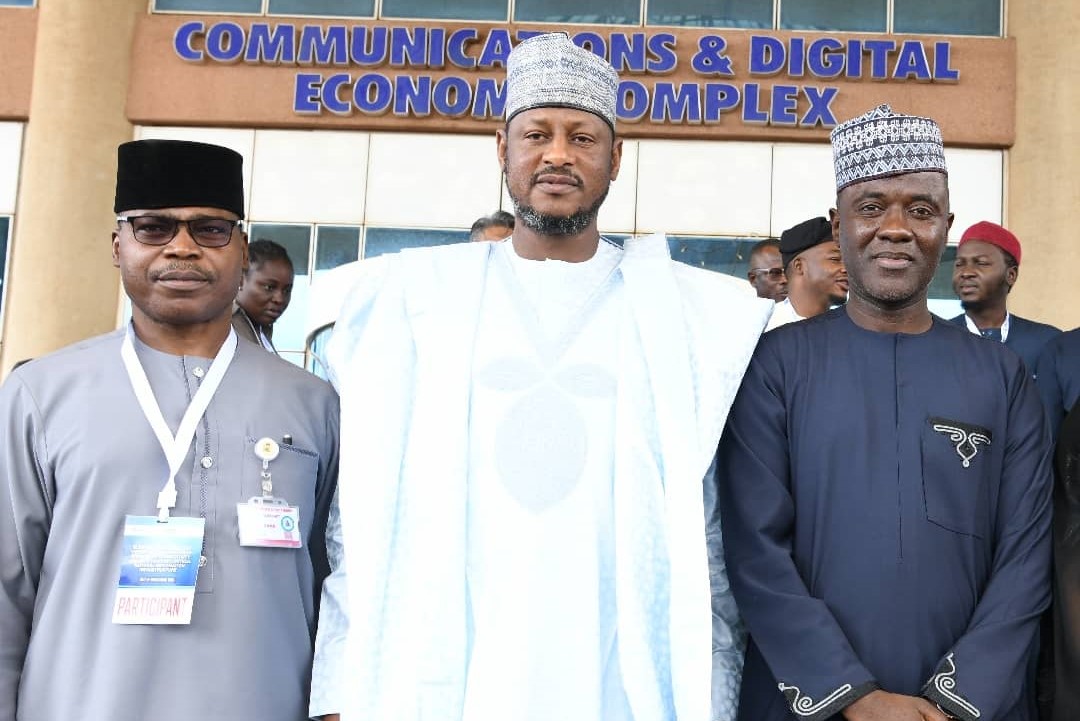
Executive Vice Chairman (EVC) of the Nigerian Communications Commission (NCC), Dr. Aminu Maida, has issued a bold call for unified action to fast-track broadband rollout across Nigeria, warning that delays could leave millions behind in the global digital economy.
Speaking at a high-level Business Roundtable on Broadband Investment and Critical Infrastructure Protection, held at the NCC’s Digital Economy Complex in Mbora, the EVC urged state governments and private sector leaders to align with national policies that support connectivity expansion and infrastructure protection.
The theme of the roundtable, “Right of Way and Protection of Broadband Infrastructure – The Road to Success in Broadband Investment and Connectivity,” underscored the urgent need to eliminate key barriers to digital growth.
“Connectivity is No Longer a Luxury It’s Survival”
Opening his remarks with a thought-provoking question “How much is an hour of connectivity worth?” Dr. Maida painted a picture of how essential digital access has become in everyday life, from traders in Kano to security operatives nationwide.
“Connectivity is the quiet enabler,” he said. “When it fails, opportunities vanish, productivity stalls, and in some cases, lives are at risk.”
With over 140 million Nigerians now online and broadband penetration standing at 48.81% as of August 2025, the EVC noted that digital infrastructure is already a key driver of the country’s economic growth contributing significantly to GDP and opening up new income streams, especially for youth and entrepreneurs.
The Numbers Tell the Story
Citing international research, Dr. Maida revealed that a 10% increase in broadband penetration can boost GDP by up to 1.38% in developing economies. With Nigeria targeting 70% broadband penetration by the end of 2025 under the National Broadband Plan, he stressed that the payoff could be transformational.
“Imagine what a 30% or 40% increase would mean billions in economic output, new jobs, and innovation hubs across the states,” he added.
Infrastructure Under Threat
Despite the progress, Dr. Maida warned that the industry still faces serious challenges particularly in terms of vandalism and poor coordination between governments and telecom operators.
Between January and August 2025 alone, Nigeria recorded: 19,384 fibre cuts, 3,241 equipment thefts, Over 19,000 cases of denied access to telecom sites.
“These attacks lead to prolonged outages, lost revenues, and delayed services. Infrastructure protection must now be at the centre of our collective agenda,” he said.
Presidential Backing For Infrastructure Protection
One of the biggest wins in recent months, he noted, was the Critical National Information Infrastructure (CNII) Presidential Order, signed by President Bola Ahmed Tinubu in June 2024. The order provides executive backing for law enforcement to protect telecom assets and prosecute vandals.
Dr. Maida said the NCC, in partnership with the Office of the National Security Adviser (ONSA), has already set up an Industry Working Group to implement this order and standardise infrastructure protection measures.
ONSA, he revealed, has successfully dismantled major cartels responsible for equipment theft, boosting investor confidence in the sector.
Right of Way: A Game Changer For Broadband Expansion
A major bottleneck to broadband rollout, the EVC emphasized, remains the high cost of Right of Way (RoW) across many states, despite the Nigerian Governors Forum’s recommendation of N145 per linear meter.
However, there is growing momentum: 11 states, including Adamawa, Bauchi, Enugu, Benue, and Zamfara, now offer zero RoW charges. 17 states have aligned with the NGF benchmark of N145 per metre.
“Where states have waived or reduced RoW fees, operators are investing more confidently,” said Dr. Maida.
He also advocated for a “dig-once” policy to reduce fibre damage during road construction and cut costs by coordinating civil works between agencies and operators.
Over $1 Billion In New Broadband Investments Coming
In a significant boost to the sector, Dr. Maida disclosed that telecom operators have committed over $1 billion in new broadband rollout investments, following recent regulatory approvals that allow for cost-reflective and competitive tariffs.
The NCC has also commissioned a national Fibre Study to ensure fair access to backbone infrastructure for smaller Internet Service Providers (ISPs), unlocking last-mile connectivity in underserved areas.
Transparency is another focus area, with the Commission ramping up the publication of network outage reports, quality-of-service dashboards, and other performance indicators.
The Road Ahead: A Shared Mission
While acknowledging progress, the NCC boss stressed that building a truly connected Nigeria requires urgent, unified action.
“Time is not on our side. Communities without digital access are already being left behind, invisible in the new economy,” Dr. Maida warned.
He Called On Governors And State Leaders To: Waive or reduce RoW fees in line with national guidelines.
Adopt clear service-level timelines for infrastructure approvals.
Institutionalise coordination between public works and telecom operators.
Support energy resilience through hybrid or solar-powered base stations.
Create digital infrastructure funds to attract private investment in rural areas.
New Tools For The Digital Push
To support this drive, the NCC will tomorrow launch two key strategic tools:
1. The Ease of Doing Business Portal, a centralized digital platform linking investors to all 36 states and the FCT.
2. Nigeria Digital Connectivity Index (NDCI), an annual scorecard that ranks each state’s digital readiness and competitiveness.
The Bottom Line: Align or Be Left Behind
Closing his remarks, Dr. Maida made a compelling call to action:
“Pipelines of oil are giving way to pipelines of fibre. The prosperity of our people now lies in data, connectivity, and human potential. Let us align, invest, and protect for the future of our nation.”
It will interest you to know that the Nigerian Communications Commission (NCC) is the regulatory authority for the telecommunications sector in Nigeria, committed to driving inclusive digital transformation through broadband expansion, fair regulation, and infrastructure protection.