
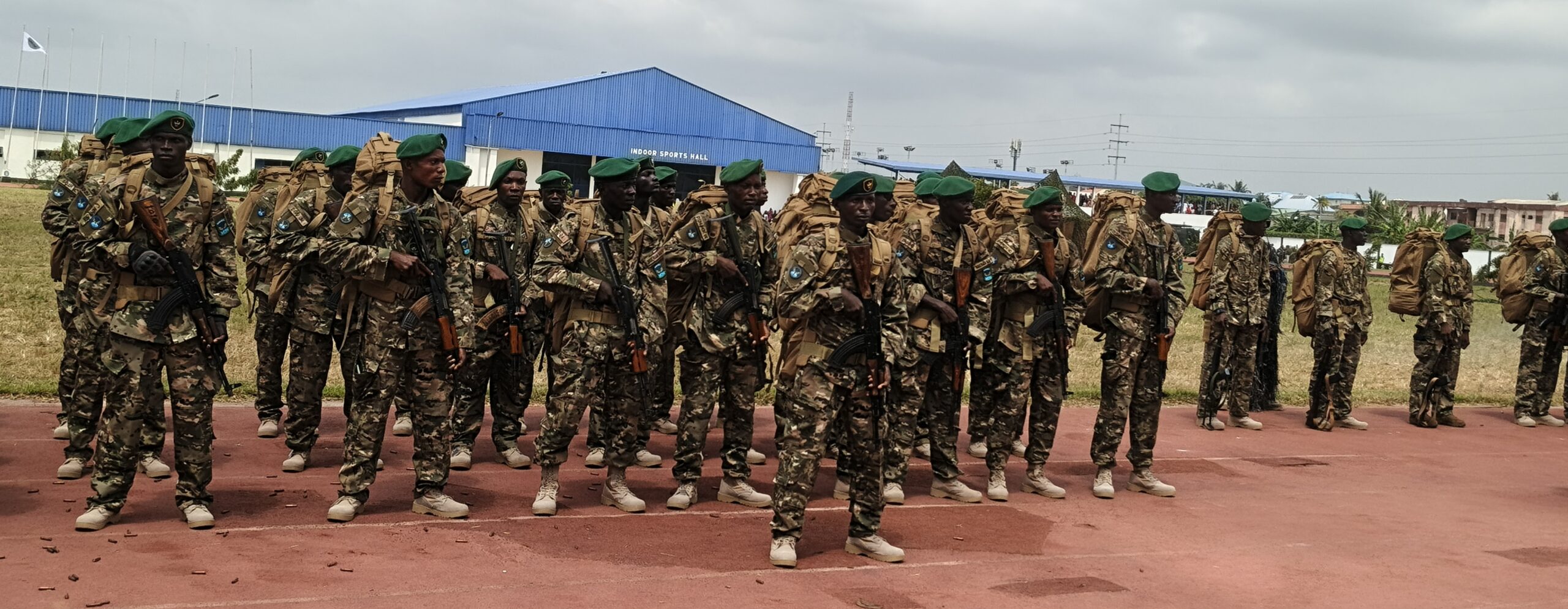
The graduation of the pioneer Nigerian Navy Marines on Friday marked a watershed in Nigeria’s evolving maritime security architecture, as the Chief of Defence Staff (CDS) General Olufemi Olatubosun Oluyede declared the force a decisive bridge between land and sea operations. The ceremony signposted what military authorities described as a bold recalibration of Nigeria’s response to emerging threats across the Gulf of Guinea.
The CDS said Nigeria’s strategic location within the Gulf of Guinea imposes an obligation to safeguard vital sea lines of communication, oil and gas infrastructure and coastal communities whose livelihoods depend on maritime stability. He stressed that protecting national sovereignty and economic assets remains a constitutional duty of the Armed Forces of Nigeria.
Commending the Nigerian Navy’s operational footprint from inland waterways to the Exclusive Economic Zone, the defence chief noted that asymmetric threats, maritime crime and hybrid security challenges necessitated a more adaptive force posture. The creation of the Marines, he explained, aligns with a doctrine of capability consolidation and reinforced jointness.
He lauded the Chief of the Naval Staff, Vice Admiral Idi Abbas, for bringing the project to fruition, while acknowledging the foundational role of his predecessor, Vice Admiral Emmanuel Ikechukwu Ogalla. According to him, continuity in strategic vision has enabled the Navy to consolidate earlier maritime security gains.
Addressing the graduands, the CDS described them as an elite force forged through rigorous physical conditioning, mental resilience drills and advanced tactical training benchmarked against Special Forces Tier 2 standards. He cautioned that future adversaries would be adaptive and unconventional, urging them to remain disciplined, innovative and guided by integrity.
He expressed appreciation to President Bola Ahmed Tinubu for sustained support to the Armed Forces, and commended international partners for technical collaboration that shaped the Marines’ training architecture.
In his remarks, the Chief of the Naval Staff described the graduation as a defining milestone in the Navy’s transformation agenda. He disclosed that the Marines were conceived under the Special Operations Command established eight months ago to deepen precision strike, counterterrorism and amphibious capabilities across maritime and riverine theatres.
He explained that the Marines would operate in synergy with the Nigerian Navy Special Boat Service to provide amphibious depth and rapid deployment capacity across littoral and inland environments. The broader security climate, he noted, demands a force structure that is agile, mobile and capable of multi-domain operations.
The Commandant of the Nigerian Navy Marine Training Centre
highlighted that the Nigerian Navy Marines, formally established on 1 June 2025, are codenamed the “Bushmen” and structured as a light infantry and special operations-capable component of the Navy. Their mandate spans expeditionary, amphibious and littoral warfare in support of national security objectives.
He disclosed that the six-month Basic Marines Qualifying Course 1, which commenced on 14 August 2025, was preceded by a Knowledge Exchange Programme involving the Seenergy Defence Group and the United States Special Operations Forces Liaison Element. The engagement harmonised doctrine and refined tactics tailored to Nigeria’s operational realities.
Training progressed through three phases, physical conditioning, land and jungle warfare, and amphibious operations, each culminating in coded camps: Camp Ibere, Camp Yaki and Camp Anyiemechaala. A final joint exercise integrating special operations forces, combat enablers and conventional units tested operational integration and decision-making under stress.
At the climax of the ceremony, the Commandant, Commodore Olayinka Ayodele Aliu, formally inducted 328 officers and ratings, including Lt CS Orji, into the First Nigerian Navy Marine Regiment under the Special Operations Command. With the Navy’s rallying call, “Onward Together,” the pioneer Bushmen stepped forward as Nigeria’s newest line of defence across its vast and volatile maritime frontier.