
Post-airstrike assessments have confirmed massive destruction of terrorist hideouts in Tangaza Local Government Area of Sokoto State, following coordinated joint air operations involving United States forces, with missile debris later recovered across parts of Sokoto, Kebbi and Offa in Kwara State.
Military findings from the post-strike exploitation indicate that the targeted forest enclave was completely neutralised, with sources describing the operation as one of the most decisive blows against terrorist elements operating in the axis.
The assessment was carried out at first light on December 26, 2025, by troops of 8 Division, Sector 2 of Operation Fasan Yamma, in collaboration with the Combat Intelligence Brigade (CIB) VII. The operation focused on Bauni Forest around Waria and Alkassim villages, a known terrorist haven.
According to senior military sources, the impact areas were extensively burnt, with clear evidence that the targeted elements were fully decimated during the precision airstrikes.
Importantly, the assessment confirmed that no civilian casualties were recorded during or after the operation, underscoring the precision and intelligence-driven nature of the strike.
In a related development, troops of 1 Brigade, Counter-Terrorism Battalion 12, stationed at Forward Operating Base (FOB) Jabo in Kebbi State, reported hearing an aircraft overhead, followed shortly by an explosion approximately one kilometre away.
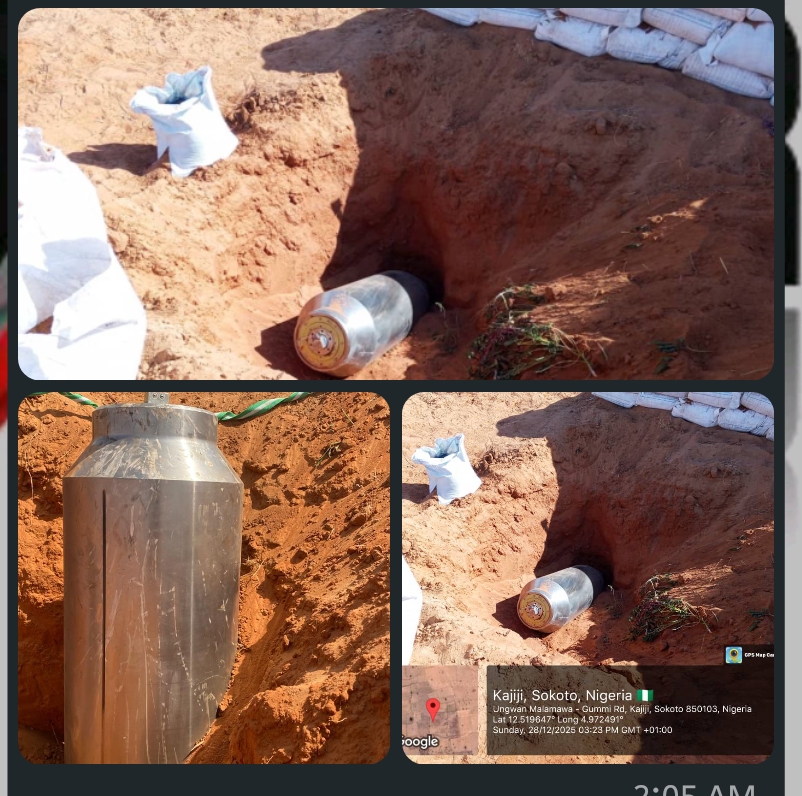
The troops immediately mobilised to Kajiji town in Tambuwal Local Government Area of Sokoto State, where they discovered debris believed to be part of an aerial device. Military sources confirmed that no human casualties were recorded at the location.
Subsequent patrols conducted later the same day led to the recovery of another object in Kajiji village, identified as a metallic canister suspected to have been released along the flight trajectory of the missiles used during the Tangaza operation. The area was swiftly cordoned off pending technical evaluation by an Explosive Ordnance Disposal (EOD) team.
Further technical clarification by military engineers revealed that the recovered objects were fuel boosters from Tomahawk missiles deployed during the air operation.
Sources explained that these boosters are designed to detach automatically shortly after launch, once sufficient propulsion has been achieved. Analysis indicated that 16 missiles were fired during the operation, resulting in the release of 16 fuel boosters.
So far, three boosters have been recovered, two within Sokoto State and one in Offa, Kwara State. Military experts disclosed that the projected landing zones of such boosters are normally calculated before launch, adding that coordination with partner forces could help provide precise drop-point data to enable faster and safer recovery operations.
According to military sources, each booster weighs approximately 300 kilograms and is capable of penetrating up to two metres into soft ground upon impact. While the overall risk to civilians remains minimal, authorities acknowledged that uncontrolled landings may cause collateral damage, as reportedly observed in Offa.
Investigations into the full circumstances surrounding the debris recovery are ongoing.
Senior military officials, who spoke on condition of anonymity, stated that lessons drawn from the post-airstrike assessment would be applied to strengthen inter-agency coordination, enhance safety protocols, and improve operational synergy in future joint missions.
They reaffirmed the military’s commitment to sustained offensive operations aimed at dismantling terrorist networks and restoring lasting security across Nigeria’s northwest and adjoining regions.