
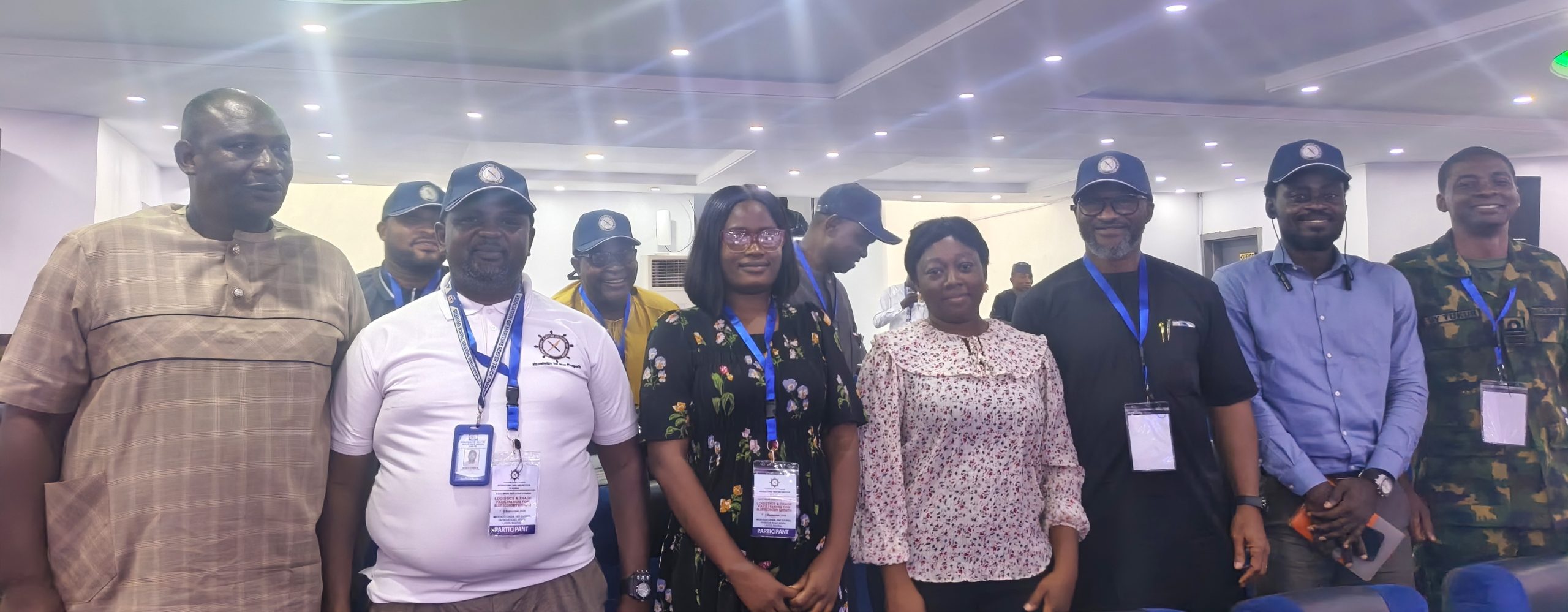
The International Maritime Institute of Nigeria (IMION) has advocated a coordinated and digitally enabled port to hinterland cargo movement system to tackle persistent delays, congestion and high logistics costs affecting Nigeria’s maritime and trade sectors.
The proposal was presented by Group One during the three day Executive Programme on Logistics and Trade Facilitation for Blue Economy Growth, held at the IMION Auditorium, NNS QUORRA, Apapa Road, Apapa, Lagos.
The programme, which commenced on September 10, 2026, brought together maritime professionals and stakeholders to examine practical strategies for improving logistics, trade facilitation, Customs modernisation, sustainable blue economy development and Nigeria’s maritime competitiveness.
Presenting the Group One capstone project under Track A, Port Hinterland Cargo Flow, Mr Patrick Ocheme Michael of the Association of Maritime Reefer Truck Owners (AMRTO), alongside other members of the team, said Nigeria must move beyond isolated interventions and begin to treat the cargo chain as one integrated system.
The project, titled “Building a Faster, Smarter and More Coordinated Cargo Movement System in Nigeria,” identified prolonged truck waiting and turnaround times, terminal congestion, repeated checks, poor information sharing and unpredictable truck scheduling among the major challenges confronting cargo evacuation.
According to the team, additional burdens include high transport costs, demurrage and storage charges, delays for importers and businesses, excessive fuel consumption and emissions, as well as the loss of competitiveness suffered by Nigerian ports.
The team observed that the challenge was not necessarily the absence of infrastructure alone, stressing that a major weakness remained the poor coordination among the various components of the cargo movement chain.
It explained that cargo typically moves from ship to port, terminal and Customs clearance before evacuation by truck, rail or barge through roads to inland destinations and ultimately to customers. At several points, however, delays, queues, inspections, documentation problems and traffic congestion create additional costs.
The capstone project identified fragmented processes, inadequate cargo and truck information sharing, unpredictable truck arrivals, repeated physical inspections, weak inter agency coordination and inadequate transport alternatives as key root causes of the problem.
Other challenges identified included poor planning at inland destinations, limited real time visibility of cargo movements, manual and duplicated documentation, as well as inadequate utilisation of rail and inland waterways for cargo evacuation.
To address the challenges, the group proposed a One Coordinated Port to Hinterland System, anchored on six major interventions: a single cargo movement plan, smart truck appointment scheduling, shared digital information, risk based inspection, inland destination readiness and a real time performance dashboard.
The proposed truck appointment system would align truck movements with cargo readiness, terminal capacity and destination availability, while digital information sharing would enable ports, terminals, shipping lines, Customs, truckers and inland destinations to access relevant information in a timely manner.
The team also recommended greater reliance on risk based inspection, arguing that high risk consignments should receive appropriate scrutiny while compliant and low risk cargo should benefit from faster clearance processes. It further advocated greater use of rail and inland waterways to reduce pressure on roads.
For implementation, the group proposed a phased approach beginning with a 90 day diagnostic and stabilisation period, followed by a first year pilot involving truck scheduling, information sharing, automation and training. Years two and three would focus on integration, while years four and five would target national transformation and wider adoption of smart port capabilities.
The project assigned specific responsibilities to stakeholders including the Nigerian Ports Authority, Nigerian Maritime Administration and Safety Agency, Nigeria Customs Service, terminal operators, shipping lines, truck owners and associations, Lagos State authorities, rail and inland waterway operators, inland destinations and technology providers.
The group said the success of the initiative should be measured through key performance indicators including truck turnaround time, cargo dwell time, delivery lead time, schedule reliability, safety and security incidents, logistics costs, digital transaction rates and the proportion of cargo moved by rail or barge.
It stressed that every performance indicator must have a clearly identified data owner, reporting frequency, baseline and target, adding that the ultimate objective was to achieve less waiting, reduced congestion, lower logistics costs, faster delivery, improved safety and reduced emissions.
The team further warned that resistance to change, poor inter agency cooperation, unreliable data, technology failures, corruption, unofficial payments, poor road conditions, inadequate funding and weak compliance could undermine the initiative. It therefore recommended transparent digital records, clear institutional responsibilities, regular stakeholder meetings, public performance reporting and continuous monitoring.
The project linked efficient cargo evacuation directly to Nigeria’s blue economy ambitions, arguing that faster and more predictable cargo movement would improve trade facilitation, strengthen port competitiveness, support logistics businesses and employment, enhance safety and security, and reduce environmental impact.
The group concluded that Nigeria’s priority should not be limited to building new infrastructure, but should also focus on making existing infrastructure and stakeholders function as one coordinated cargo ecosystem. It projected that within five years, Nigeria could have a digitally visible and measurable port to hinterland system capable of delivering cargo faster, safer and at lower cost.
Members of Group One included Commodore SO Ohunenese, Olivia Fatima Anyaegbunam, Patrick Ocheme Michael, Captain UY Tukur, Francis Odiari, Adekitan Talabi, Jessica Jonathan, Osahon Omonjiade, Victor Enebeli, Jamiu Balogun and Ogechukwu Ifeme.
The central message of the capstone project was summed up by the team thus: “When information moves faster, cargo moves faster. When stakeholders work as one system, Nigerian ports become faster, safer, cheaper and more competitive.”