
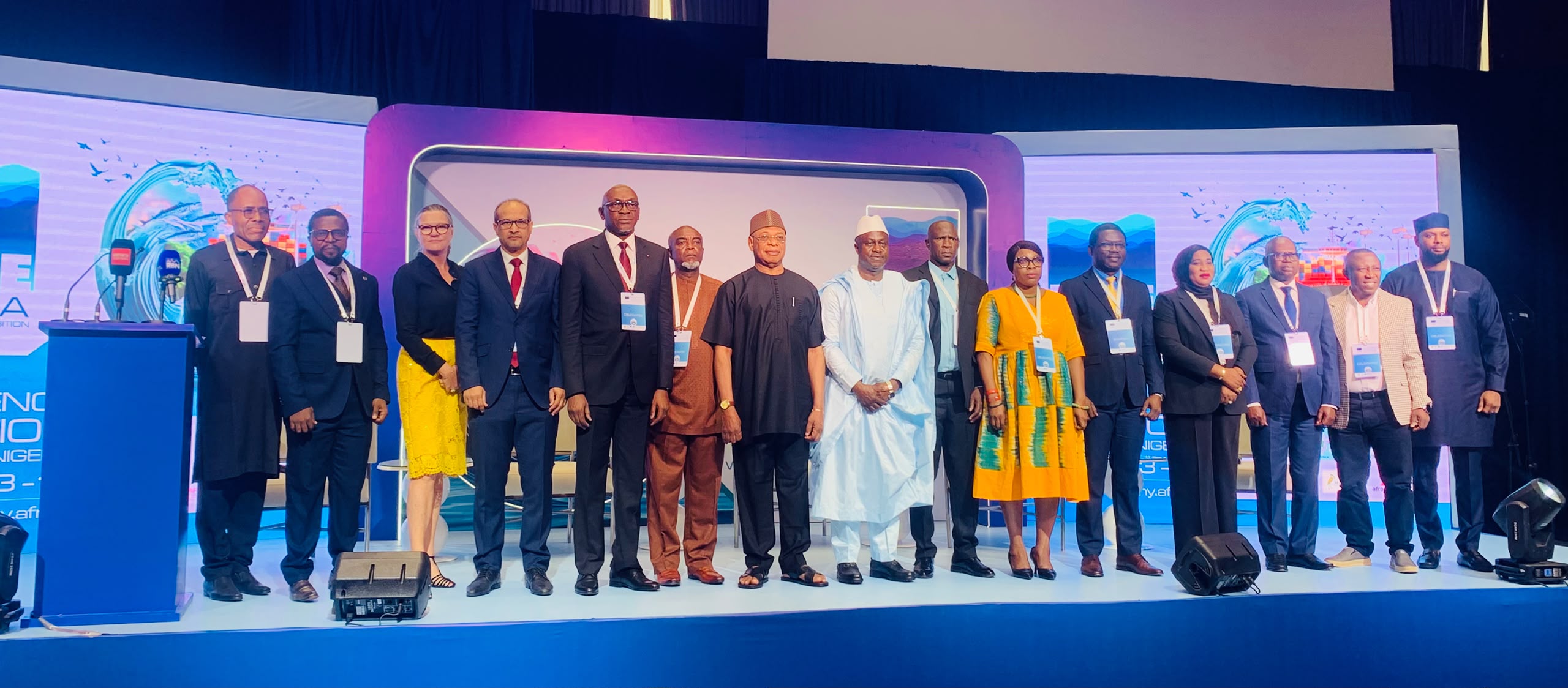
Africa must stop generating maritime value only to export it, and instead own, finance, and govern its oceans, Dr Paul Adalikwu, the Secretary-General of the Maritime Organization of West and Central Africa (MOWCA)stated this in Lagos on Thursday August 13, 2026 at the opening session of the maiden edition of the Blue Africa Conference & Exhibition 2026 held in Lagos.
Delivering an address titled “Setting the Course for Africa’s Maritime Future: From Blue Potential to African Maritime Power,” the MOWCA scribe painted a stark picture of the continent’s maritime paradox: more than 30,000 kilometres of coastline, strategic trade routes, vast fisheries, and offshore energy resources, yet foreign ownership of ships, external financing, imported technology, and offshore insurance continue to drain value from the continent.
He said “Africa generates maritime value but does not retain it,” adding that “This imbalance must be corrected.”
The two-day conference, holding in Lagos on 14–15 August under the theme “From Maritime Potential to African Maritime Power,” is expected to draw ministers, industry captains, financiers, and development partners. The Secretary-General used the platform to call for a decisive shift from fragmented national approaches to a unified continental maritime architecture.
“One Africa. One maritime voice. One strategic direction,” he stated. “This is not about reducing sovereignty, it is about strengthening it. No African state can shape global maritime systems alone. Together, Africa is a maritime power of global consequence.”
The MOWCA SG talked about a five-year imperative for measurable progress toward maritime integration,stating that governments must place maritime development at the heart of economic strategy with ports collaborating rather than compete in isolation.
He added that the private sector must increase ownership of the value chain, and financiers must treat maritime assets as productive capital.
Speaking on maritime financing, Adalikwu pushed for a Maritime Bank of Africa, stating that MOWCA is advancing to mobilise patient capital, blended finance, guarantees, and long-term equity and debt to fund ports, African shipping fleets, shipyards, fisheries, offshore renewables, maritime technology, security infrastructure, and skills development.
“No maritime transformation is possible without finance,” the Secretary-General said. “Africa cannot build competitive ports, fleets, shipyards, and blue industries on external capital alone. The question is simple: Can Africa finance its own maritime future? Our answer must be yes.”
He insisted the Blue Economy must move beyond slogans to genuine ownership across the value chain, vessels, ports and logistics, technology, fisheries processing, marine data, ship repair, maritime finance, and intellectual property. Africa, he argued, must stop asking only what it can attract and start asking what it can own, build, and scale.
Linking the maritime agenda to the African Continental Free Trade Area, he stressed that ports are only as strong as their hinterland connections. Ocean-to-hinterland corridors, efficient logistics, rail, road, and customs systems are essential if maritime infrastructure is to drive industrial transformation.
His message to delegates and exhibitors framed maritime space as economic infrastructure rather than pure enforcement. Investment, trade, and insurance all follow confidence and reduced risk. Evolving threats, piracy, illegal fishing, trafficking, cyber risks, and climate vulnerabilities, must be met with sustained investment that protects jobs and revenue.
The Secretary-General said, people remain the real infrastructure. Africa’s youth must be trained as seafarers, naval architects, port professionals, maritime lawyers, data specialists, cybersecurity experts, and entrepreneurs who are “African in origin, global in competence, and competitive anywhere in the world.”
He challenged the conference to move beyond dialogue. Success, he said, would be measured by stronger alignment on cooperation, a coalition behind the Maritime Bank of Africa, a pipeline of bankable projects, and a clear framework for African ownership of the maritime value chain.
“History will judge us not by Africa’s maritime potential, but by what we did with it,” he concluded. “The ocean is not a barrier, it is Africa’s gateway to the future. But it must be owned, financed, and developed by Africans.
“Africa must be an owner. Africa must be a partner. Africa must be a leader. The time to act is now. The future is blue. The future is African.”