
For decades, the image of border enforcement has been dominated by patrol vehicles, checkpoints, physical searches and the familiar cat-and-mouse game between Customs officers and smugglers.
But along the Nigeria-Benin frontier, a new dimension is beginning to emerge, one in which information, technology, geospatial intelligence and coordinated risk assessment may prove more decisive than the sheer number of boots deployed to the border.
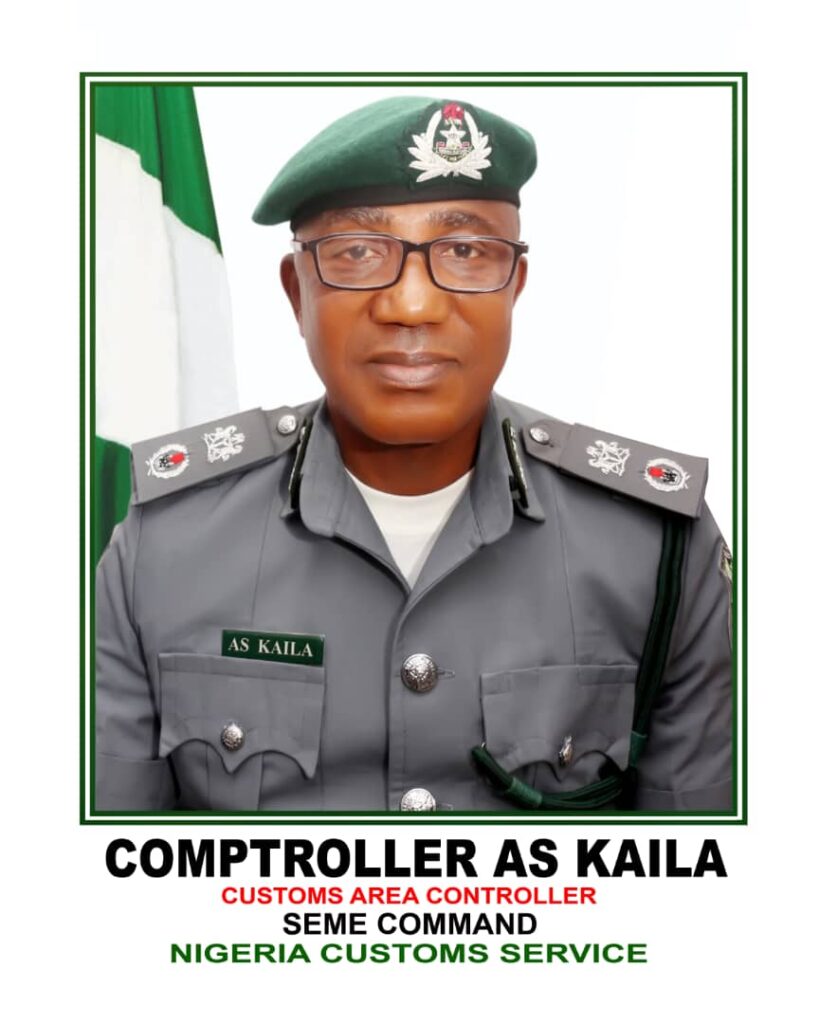
That is the emerging story around the Seme Area Command of the Nigeria Customs Service under Comptroller Abdullahi Kaila, a veteran enforcement chief and savvy bent administrator.
Barely months into his tenure at Seme, Kaila appears to be operating within a broader Customs philosophy that seeks to marry enforcement with technology and trade facilitation. And developments along the Nigeria-Benin corridor suggest that the future of border security may increasingly be determined before the offending vehicle, cargo or smuggler gets anywhere near the checkpoint.
The clearest evidence came earlier this month July with Operation GEOCONTROL, a joint Nigeria-Benin Customs operation conducted with the support of the World Customs Organization and Japan International Cooperation Agency.
The eight-day operation marked the first WCO-led operational deployment in which geospatial intelligence, or GEOINT, was deployed as a core Customs enforcement capability. Officers from both countries combined geospatial analysis, risk profiling and field intelligence to identify smuggling routes, map high-risk areas and coordinate enforcement actions across official crossing points and vulnerable border zones.
The results were significant: 37 seizures involving narcotics, pharmaceuticals, petroleum products and consumer goods. But the bigger story is not necessarily the seizures themselves. It is the methodology.
The operation deployed the WCO Geoportal, geographic information systems, drones, secure communications and other analytical tools to develop what the WCO described as a shared operational picture of the border environment. In practical terms, this means Customs is beginning to move from simply reacting to what officers physically encounter to predicting where illicit activity is most likely to occur.
For Seme, that is a potentially transformational development. The corridor is too vast, too commercially active and too porous for conventional enforcement alone to provide a complete solution. The border economy involves legitimate traders, transporters, manufacturers, freight forwarders, travelers and residents whose activities must be protected, even as Customs confronts smugglers exploiting the same routes.
The challenge, therefore, is no longer merely how to stop more vehicles. It is how to know which vehicles, routes, consignments and patterns deserve greater scrutiny; and which legitimate businesses should be allowed to move with minimum interruption.
That is where intelligence-led Customs administration becomes particularly important. Kaila’s early operational agenda has already placed emphasis on intelligence-driven enforcement, compliance and the reduction of revenue leakages. At his first media briefing, he reported that Seme generated ₦9.798 billion between March and May 2026, compared with ₦2.188 billion during the corresponding period of 2025 an increase of about 448 per cent.
He attributed the improvement to stronger compliance mechanisms, stakeholder cooperation, anti-revenue-leakage measures, operational efficiency and the deployment of the B’Odogwu Unified Customs Management System. That figure is important, but the more consequential question is what produced it.
If technology and intelligence are helping Customs to identify risk more accurately, then enforcement becomes less dependent on indiscriminate physical intervention. A compliant trader benefits from faster processing, while the Customs Service concentrates its resources on the activities that genuinely threaten national revenue, public safety and economic security.
This is the delicate balance that Kaila, given every one of his body languages is striving to maintain. The temptation at any major border is to measure success by seizures alone. But a modern border command must be judged by a broader scorecard: how much legitimate trade it facilitates, how much revenue it protects, how effectively it disrupts criminal networks and how little unnecessary friction it creates for compliant operators.
Kaila’s early engagements with traditional rulers, security agencies, customs brokers, freight forwarders, transport unions, importers and exporters indicate an appreciation of this wider responsibility. The Command has said its objective includes eliminating trade barriers affecting the Lagos-Abidjan corridor, while strengthening collaboration with stakeholders and sister agencies.
That stakeholder dimension is crucial because technology alone will not defeat smuggling. The human intelligence embedded in border communities remains indispensable. Local residents know the tracks, routes and unusual movements that may escape conventional surveillance. Traditional institutions know their communities.
Security agencies possess complementary intelligence. Customs has its own risk-management and enforcement capabilities.
The real force multiplier is therefore not technology in isolation, but technology plus information-sharing plus institutional trust.
This is why Operation GEOCONTROL deserves particular attention beyond its immediate seizures. The WCO reported that Nigerian and Beninese Customs officers worked side by side, exchanging information in near real time and coordinating operations across the shared border environment.
For a frontier where criminal networks do not recognise national boundaries, this is perhaps the most logical approach. A smuggler does not stop being a smuggler simply because he crosses from Nigeria into Benin. A contraband route does not become less dangerous because it falls on the other side of an international boundary.
The implication is obvious: border enforcement itself must become transnational. For Seme, the strategic opportunity is to make this new intelligence architecture permanent and institutional rather than allowing it to remain an isolated operation.
The question now is whether GEOINT, drones, data analytics and risk profiling can become part of the everyday operational culture of the corridor.
Can Seme evolve into a border command where Customs officers know where to look before the contraband arrives?
Can technology reduce the number of unnecessary physical interventions while increasing the probability of intercepting genuine threats?
Can intelligence-led enforcement help Customs protect legitimate commerce from the unintended consequences of over-enforcement?
Those are the real tests. The future of Seme cannot be built on checkpoints alone. It must be built on precision. And that may ultimately be the most important dimension of Kaila’s emerging new Seme frontier: the possibility that the strongest Customs presence at the border may no longer be the officer standing by the roadside, but the intelligence system working quietly behind him.
In the new border economy, the Customs officer who sees first may be more valuable than the officer who searches most. For Seme, that is not merely a technological upgrade. It is a new philosophy of border management, and Kaila is gradually but diligently walking the path.