
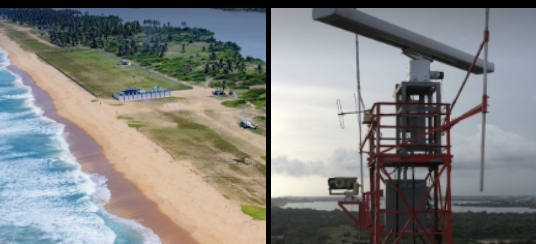
The Nigerian Navy’s recent interception of 550 kilograms of illicit narcotics at Tarkwa Bay Beach, alongside the earlier recovery of 756 kilograms of cannabis sativa in Nigerian waters, has reinforced the growing impact of advanced maritime surveillance in Nigeria’s fight against transnational crime.
The successful operations underscored the strategic value of Falcon Eye, the integrated maritime surveillance system developed by RTCOM Defense, which has continued to strengthen Nigeria’s maritime domain awareness and intelligence-led security operations.
Security experts said criminal syndicates operating across the Gulf of Guinea have traditionally relied on wooden boats to evade conventional coastal surveillance because of their low radar signature, organic construction and deliberate deactivation of Automatic Identification System (AIS) transponders.
Falcon Eye has significantly reduced that operational advantage through its high-sensitivity Over-the-Horizon (OTH) and Coastal Radar technology, capable of detecting low-radar-cross-section vessels that previously escaped conventional monitoring.
Beyond vessel detection, the surveillance platform employs advanced behavioural analytics to assess movement patterns, speed, heading and sailing routes against established trafficking profiles, enabling security agencies to identify suspicious activities in real time.
During the latest anti-smuggling operation, intelligence generated by Falcon Eye reportedly enabled naval commanders to bypass lengthy manual search procedures by accurately identifying the suspect vessel and projecting its interception route.
The intelligence-driven operation allowed the Nigerian Navy’s Quick Response Force from NNS BEECROFT to move directly to the target location, intercepting the vessel in the early hours and preventing narcotics valued at about ₦500 million from reaching the domestic market.
Maritime security analysts described the operation as another demonstration of how technology-driven surveillance is transforming Nigeria’s maritime security architecture, improving operational efficiency while reducing response time against organised criminal networks.
Since its nationwide deployment in 2021, Falcon Eye has continued to enhance maritime domain awareness by combining persistent radar coverage with real-time intelligence, making Nigeria’s coastal waters increasingly hostile to drug traffickers, oil thieves and other maritime criminals.
The latest successful interceptions further highlight the expanding role of advanced surveillance technology in safeguarding Nigeria’s maritime environment. As Hybrid News reports, the integration of intelligence, radar technology and rapid naval response is steadily strengthening national security while reinforcing Nigeria’s determination to deny transnational criminal syndicates safe access to its territorial waters.