
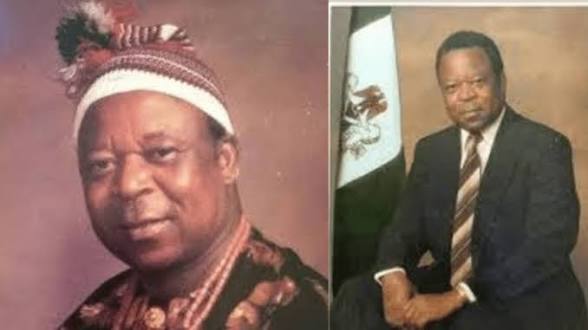
The enduring legacy of late former Imo State Governor, Samuel Onunaka Mbakwe, has once again ignited public discourse on governance, infrastructure development, and leadership accountability in Nigeria’s South East.
More than four decades after his tenure ended, Mbakwe’s achievements continue to dominate conversations whenever examples of transformational leadership are discussed across the region.
A recent commentary by public affairs commentator Alvan Chinaka challenged citizens and political leaders to revisit the records of the former governor and critically examine how so much was reportedly achieved within a single four year tenure.
Mbakwe served as the first democratically elected governor of old Imo State from October 1979 until December 1983 during Nigeria’s Second Republic.
At the time, old Imo State comprised the territories that today make up Imo State, Abia State, Enugu State and Ebonyi State, making it one of the largest administrative territories in the country.
Supporters argue that despite limited financial resources and difficult relations with the federal authorities of the era, Mbakwe embarked on ambitious projects that altered the economic landscape of the region.
Among the most celebrated achievements of his administration was the construction of the Sam Mbakwe International Cargo Airport, widely regarded as a symbol of collective community participation and visionary leadership.
The airport project reportedly benefited from extensive grassroots mobilization and contributions from communities across the old Eastern region.
Observers note that the project demonstrated Mbakwe’s ability to rally citizens behind a common developmental objective despite significant financial limitations.
Agriculture also occupied a central place in his development strategy.
His administration established the famous Avutu Poultry Farm in Obowo, which was considered one of the largest poultry ventures in West Africa during its peak years.
The government also developed the Adapalm Plantation in Ohaji Egbema and Oguta axis, a large scale agricultural enterprise that created employment opportunities and boosted palm oil production across the region.
Another notable investment was the Golden Chicken Poultry Farm in present day Abia State, reflecting a development agenda that extended beyond the boundaries of present day Imo State.
Industrialisation formed another pillar of Mbakwe’s vision.
His administration reportedly established more than one hundred industrial and commercial ventures aimed at stimulating local production and reducing dependence on imports.
Among these projects was the Amaraku Power Station, frequently cited as one of Nigeria’s earliest state driven electricity generation initiatives.
The administration also established an aluminium extrusion plant in Inyishi to support the construction sector and encourage local manufacturing.
Industrial facilities such as the Resin and Paint Manufacturing Plant in Aboh Mbaise, the Imo Glass Industry, the Standard Shoe Industry and the Nsu Ceramic Industry were also developed during the period.
These enterprises were designed to create jobs, stimulate economic activity and build an integrated production chain within the state.
The government equally invested in paper production and packaging industries, while strengthening media development through state owned publishing ventures.
In the hospitality sector, the iconic Concorde Hotel Owerri emerged as one of the administration’s flagship projects and became a major symbol of modern urban development.
Education received significant attention under Mbakwe’s leadership.
His administration established what later evolved into Abia State University after state creation exercises altered territorial boundaries.
He also founded institutions that later became the foundation for the growth of technical and agricultural education in the region, including Federal Polytechnic Nekede and the College of Agriculture Umuagwo.
Beyond infrastructure and education, Mbakwe pursued aggressive rural development programmes.
His government initiated numerous water projects, expanded electricity access to communities and embarked on extensive road construction across urban and rural areas.
The administration also developed the Owerri Capital City Master Plan and introduced urban drainage systems that were considered among the most advanced in Nigeria at the time.
Analysts say the continued relevance of Mbakwe’s record stems from the comparison many citizens draw between his four year tenure and the performance of successive administrations that enjoyed longer periods in office and larger financial allocations.
For many residents of the South East, the Mbakwe era remains a benchmark against which governance is measured.
The debate, however, extends beyond nostalgia. It raises broader questions about leadership priorities, resource management and the capacity of governments to deliver meaningful development regardless of financial constraints.
As conversations surrounding his legacy continue, one reality remains clear: decades after leaving office, Mbakwe’s name still occupies a prominent place in discussions about effective governance, public service and transformational leadership in Nigeria.
Whether viewed as an exceptional administrator or as a standard that future leaders must strive to surpass, his record continues to shape political discourse across the South East and beyond.