
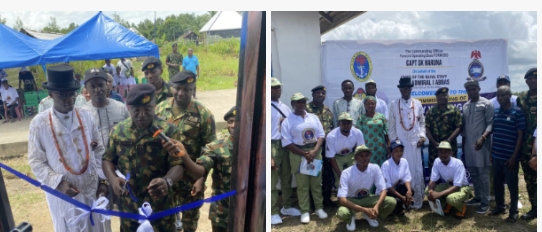
Residents of Liama Community in Brass Local Government Area of Bayelsa State erupted in celebration on Friday as the Forward Operating Base, FORMOSO, commissioned a newly constructed jetty waiting room to ease transportation challenges in the riverine settlement.
The project, executed as part of activities marking the Nigerian Navy’s 70th anniversary, is expected to provide comfort and protection for commuters and travelers awaiting boats along the busy waterfront.
For years, residents and passengers in the community reportedly endured harsh weather conditions while waiting for transportation at the jetty, a development that made the intervention widely applauded by locals.
Speaking during the commissioning ceremony, the Commanding Officer of FOB FORMOSO, Captain SK Haruna, said the initiative was undertaken in direct response to the needs of the people of Liama Community.
He noted that the Nigerian Navy remained committed not only to securing the nation’s maritime environment but also to improving the welfare and living conditions of host communities through meaningful projects.
Haruna explained that the absence of a functional waiting area at the jetty informed the decision to construct the facility, stressing that the Navy would continue to strengthen its relationship with communities within its operational area.
The event attracted a large gathering of naval personnel, civilian staff, National Youth Service Corps members, traditional leaders, youths and other residents who turned out in appreciation of the project.
Community leader, Chief Atuka Alangba, who spoke on behalf of the people of Liama, described the gesture as timely and impactful, noting that the community had not witnessed such intervention in many years.
He expressed gratitude to the Nigerian Navy and FOB FORMOSO for identifying with the people, while pledging sustained cooperation, peaceful coexistence and support for security operations in the area.
The ceremony further underscored the Nigerian Navy’s growing commitment to civil military relations and community development, particularly in riverine communities where access to basic public infrastructure remains a major challenge.