
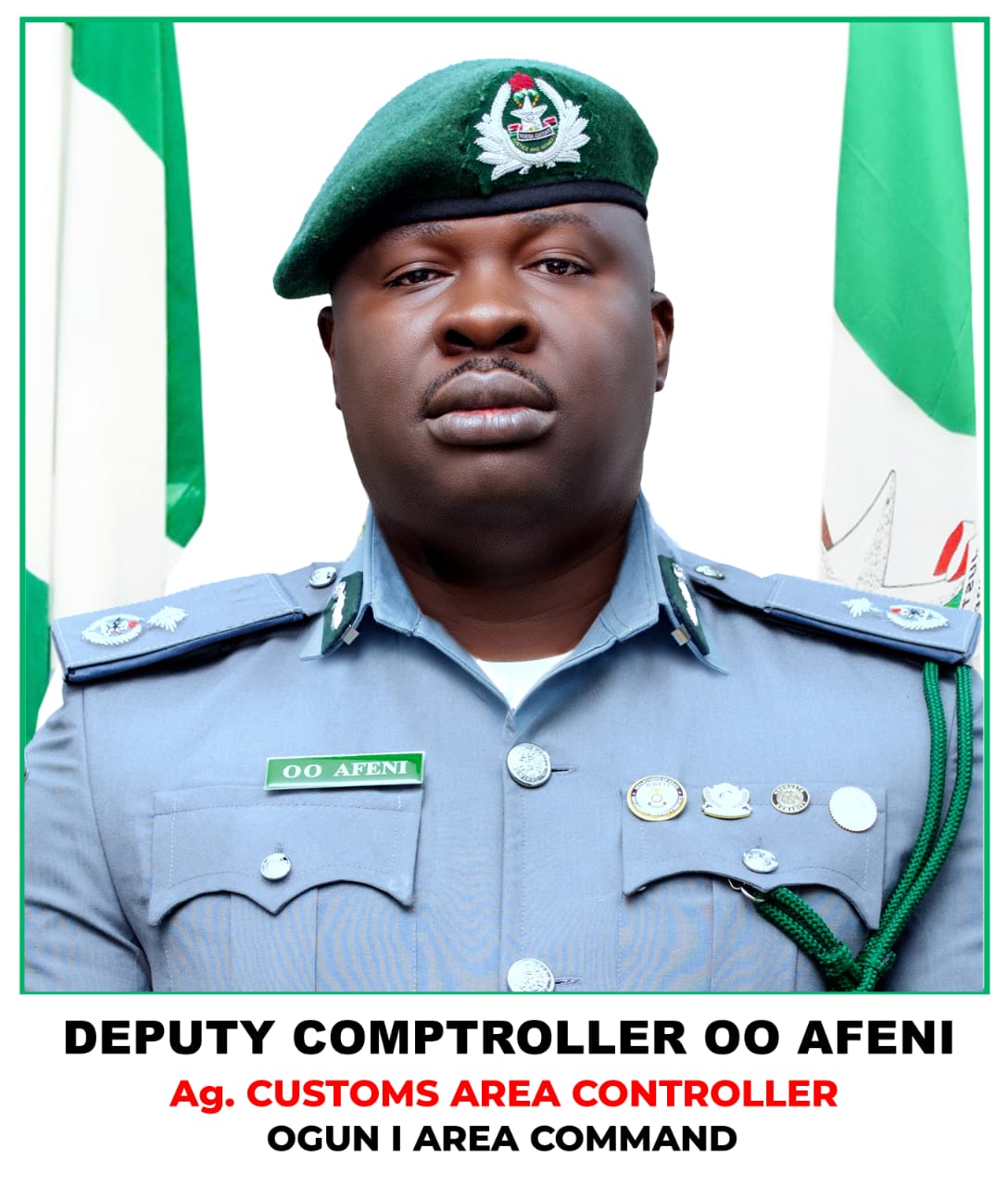
Along Nigeria’s notoriously porous western frontier, where smuggling networks have historically thrived on geography, weak border controls and entrenched informal trade, a quiet but consequential transformation appears to be unfolding at the Ogun I Area Command of the Nigeria Customs Service (NCS). At the centre of this shift is Deputy Comptroller Oladapo Afeni, whose leadership at the Idiroko border command is increasingly attracting attention for its operational intensity, intelligence-led enforcement and visible results.
In just 41 days, the Command intercepted contraband valued at N6.77 billion, a figure that speaks not only to the scale of illicit commerce along the border corridor but also to the renewed aggression of Customs operations under Afeni.
Yet beyond the statistics lies a broader story, one about institutional renewal, generational leadership and the emergence of a new crop of Customs officers increasingly equipped to reposition the Service for modern border management.
Beyond Seizures: The Afeni Template
For decades, the Idiroko border has symbolised both opportunity and vulnerability. While legitimate trade flows between Nigeria and the Republic of Benin sustain economic activities, the corridor has equally served as a major artery for narcotics, foreign rice, fuel diversion, counterfeit medicines and illicit wildlife trafficking.
What Appears Different Under Afeni Is The Operational Philosophy.
Rather than relying solely on conventional border patrols, the Ogun I Command has leaned into intelligence gathering, strategic surveillance and coordinated enforcement. The result has been a rapid succession of seizures that cut across multiple high-risk sectors.
The headline interception – 10,126 parcels of cannabis indica weighing 4,627 kilograms and valued at over N5 billion – underscored the Command’s seriousness in tackling narcotics trafficking.
From January to date, the Command reportedly intercepted over 26,000 parcels of cannabis sativa and indica combined, reinforcing concerns that the Idiroko corridor remains a critical route for transnational drug networks.
But Afeni’s intervention Extends Beyond Drugs.
Under his watch, Customs operatives seized 1,759 bags of foreign parboiled rice, 14,550 litres of Premium Motor Spirit (PMS), thousands of kegs of smuggled vegetable oil, expired food items, counterfeit pharmaceuticals and even six live pangolins – one of the world’s most trafficked endangered species.
Such seizures reflect a broader understanding of border security: that smuggling is not merely an economic crime, but one with public health, environmental and national security implications.
A New Generation Of Customs Leadership
Afeni’s performance also highlights a wider institutional reality within the Nigeria Customs Service – the emergence of younger, technologically adaptive and strategically minded officers capable of driving reforms.
Under the leadership of the Comptroller-General of Customs, Dr. Bashir Adewale Adeniyi MFR, the Service has increasingly embraced digital surveillance, geospatial intelligence and data-driven enforcement mechanisms.
The deployment of such tools at commands like Ogun I signals a transition from manpower-heavy operations to smarter, intelligence-based border management.
This Matters Because The Nature Of Smuggling Itself Is Evolving.
Criminal syndicates now operate sophisticated supply chains spanning multiple countries, exploiting porous routes, digital communication and regional market imbalances. Countering such networks requires officers who understand both enforcement and technology, a profile increasingly visible among the Service’s emerging leadership cadre.
Afeni Represents This Transition.
His approach at Idiroko reflects a blend of operational firmness, inter-agency collaboration and strategic adaptability, qualities many observers argue will define the next phase of Customs administration.
Even amid intensified anti-smuggling operations, Ogun I Command generated ₦125.43 million in revenue through baggage assessment and auctioned petroleum products while facilitating exports valued at over ₦1 billion Free on Board (FOB).
This balance between enforcement and trade facilitation reinforces an important truth about modern Customs operations: success is no longer measured solely by seizures, but by the ability to secure borders while enabling lawful commerce.
For the Nigeria Customs Service, the story unfolding at Idiroko may ultimately represent something bigger than one officer’s achievements.
It may well be an early signal that a new generation of Customs leadership is emerging – one better positioned, technologically prepared and operationally disciplined to take the Service to greater heights in an era of increasingly complex border threats.