
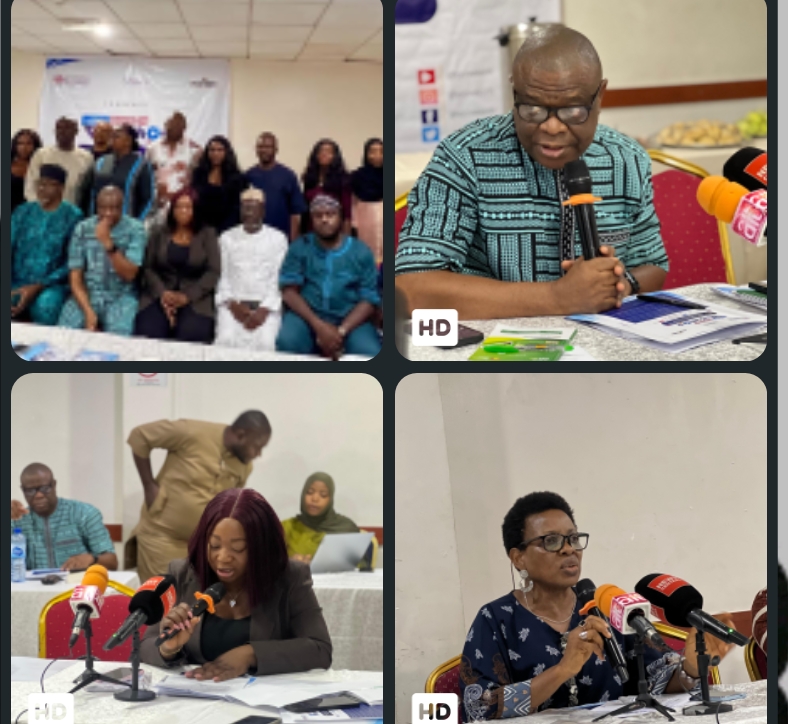
Nigeria’s National Counter Terrorism Centre of the Office of the National Security Adviser (NCTC-ONSA) and the Partnership Against Violent Extremism (PAVE) Network on Tuesday formally launched the 2026 phase of the Preventing and Countering Violent Extremism Knowledge, Innovation and Resource Hub (PCVE-KIRH), signalling a decisive shift from a purely security-driven model to a knowledge-led, whole-of-society strategy against violent extremism.
The unveiling took place in Abuja at a one-day Stakeholder Orientation Workshop in Abuja, organised by PAVE Network in collaboration with the Nextier, SPRiNG, and the UK International Development (FCDO). The event marked the PCVE-KIRH’s first official activity in 2026 and attracted government officials, civil society practitioners, academics, community advocates, and development partners.
Representing the Director of PCVE at NCTC-ONSA, Ms Iye Mangset, outlined the five strategic priorities for 2026: documenting and amplifying lessons from past interventions; expanding the geographic scope of prevention beyond historically affected regions; deepening stakeholder engagement across government and civil society; consolidating institutional gains; and strengthening youth-focused programming.
“Too often, impactful interventions go undocumented or underreported,” Mangset said.
According to her, “visibility is not about publicity; it is about accountability, learning and the replication of success.” She also underscored the growing recognition that violent extremism is a nationwide threat, cautioning that “prevention must be proactive and inclusive of all regions, including areas such as the South-South.”
PAVE Network Chairman, Mr Jaye Gaskia, described the PCVE-KIRH as a direct response to two critical weaknesses identified in Nigeria’s counter-extremism architecture: fragmented coordination and inaccessible knowledge. “What are the critical gaps in PCVE in Nigeria from a policy coordination and implementation perspective?” he told the gathering, recounting the question his team posed 18 months ago. “We picked knowledge and knowledge management” as the most high-impact answer.
The Hub, Gaskia explained, is designed to function simultaneously as a national repository of PCVE expertise, an innovation incubator, a technical support mechanism, and a learning platform. It serves as “a one-stop shop for resources and materials on PCVE” and as a space where practitioners, researchers, and policymakers can collaborate without institutional barriers.
Central to the Hub’s vision is a reframing of what drives violent extremism. “It is a failure of governance, weak governance and dysfunctional development, that creates the enabling environment for grievances to become historical grievances,” Gaskia said, “and for those grievances to then become organised.” He noted that making isolated, region-specific responses is not only insufficient but “actually ineffective,” since displaced populations and perpetrators simply relocate.
Violent extremism is not essentially a security issue; it is fundamentally a governance and development issue,” Gaskia stressed.
Speaking on the PCVE-KIRH digital platform, Gaskia noted that it hosts three integrated components: a Community of Practice for PCVE practitioners across the country; an e-learning portal through which courses and capacity-building programmes will be delivered in partnership with university centres for peace studies and the Institute for Peace and Conflict Resolution; and an e-library consolidating policy documents, research reports, and grey literature on violent extremism in Nigeria, the Lake Chad Basin, the Sahel, and beyond.
“If you are a researcher, journalist, policymaker, or simply a citizen seeking to understand PCVE, you can access relevant materials quickly and efficiently, rather than searching across multiple sources,” he added.
Gaskia also announced plans to release a “Do-It-Yourself” digital guide to help practitioners and citizens navigate the platform effectively, and noted that the initiative would support state and local governments in domesticating the National PCVE Policy. “If we are truly committed to a whole-of-society and whole-of-government approach, then the policy must enter the public domain more meaningfully,” he said.
Gaskia outlined the architecture of Nigeria’s revised National Policy Framework and Action Plan on PCVE, which rests on four core objectives: the institutionalisation of PCVE across government; justice and the rule of law, including a human rights-based approach to dealing with perpetrators and affected communities; building community resilience; and integrated strategic communication to counter extremist narratives and promote constructive ones.
He stressed that dedicated PCVE desks have now been established in ministries, departments, and agencies (MDAs), and that several states have followed suit. However, he flagged a persistent challenge: many of these desks are treated as peripheral. “Desks are created usually as an afterthought—a desk in the corner in an MDA, but not seen as part of the institution’s core mandate,” he warned. “The positioning and structure of that desk should reflect the positioning of the institution itself.”
The revised policy also introduces a resource mobilisation framework, addressing a critical gap in the 2017 original. “The new policy states clearly that the government must allocate funds before others can contribute,” Gaskia noted. On rehabilitation, he called for a shift from a perpetrator-centred to a victim-centred approach— “rehabilitation will include rehabilitating affected communities: restoring livelihoods, rebuilding homes, restoring security and dignity.”
Also speaking, Prof. Gbemisola Amimasawun, Director of the Centre for Peace and Strategic Studies at the University of Ilorin, offered a conceptual anchor for the day’s discussions. “PCVE is the ‘software’ of counterterrorism,” he said. “We cannot effectively counter terrorism without paying sufficient attention to the prevention of violent extremism.” Amimasawun argued that responses must be predicated on evidence rather than assumptions, addressing what she called the “push, pull, and enabling factors” that draw individuals into extremism, including trauma, indoctrination, and governance deficits.
Prof. Uthman Abdulqadir, Director of the Centre for Peace Studies at Usmanu Danfodiyo University, Sokoto, reported on active research projects his team is conducting in Zamfara and Kano, examining youth recruitment, ranching conflicts, and the effectiveness of community-based early warning systems. He cited a stark data point: “More than 60 per cent of Nigeria’s population is youths. If the government focuses on quality education, youth empowerment, and employment generation, we can reduce violent extremism by 80 to 90 per cent.”
Abdulqadir emphasised the role of traditional rulers, religious leaders, and community institutions in early warning mechanisms, calling on state and local governments to lead implementation. “Providing knowledge, innovation, and research is one thing; we are not the implementers,” he said. “Our role is to lay the foundation for policy formulation, develop policy guidelines, and suggest strategies for implementation.”
In the same vein, Deputy Director at the National Orientation Agency (NOA), Ms Margret Yenami, highlighted the Agency’s unique structural advantage as a critical enabler of early warning. “When you look at it from the national level, the state level, and down to the grassroots level, the Agency’s coverage is very wide,” she said. “When it comes to ensuring that the country is stable, especially regarding issues of terrorism, we receive reports regularly on actions and incidents happening at the grassroots.”
Yenami noted that terrorism-related information gathered at the community level is escalated through state- and national-level platforms, in coordination with relevant security agencies. At the same time, the Agency’s core focus within the PCVE framework remains public awareness and community enlightenment.
The first meeting of the inter-agency steering committee for 2026 is scheduled for the following week, with plans to restore quarterly coordination meetings. For a platform that aspires to transform Nigeria’s counter-extremism landscape from the inside out, the 2026 orientation workshop was, by design, only the beginning.