
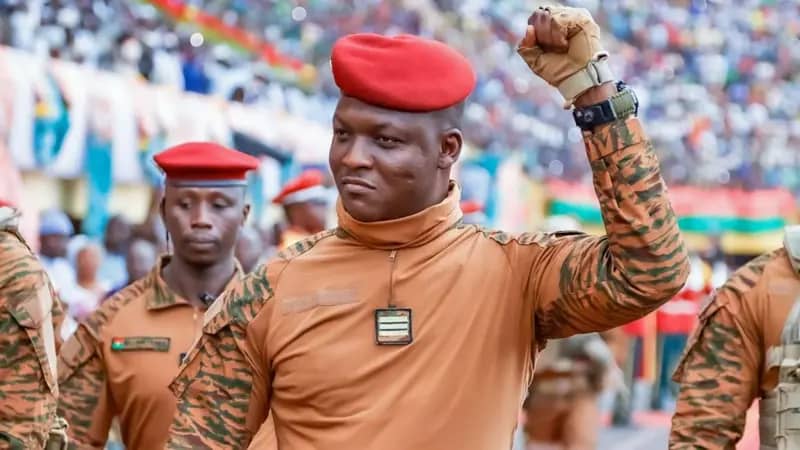
Three years after seizing power, Captain Ibrahim Traoré continues to present himself as the heir to Thomas Sankara, a revolutionary voice rising from the Sahel. But what Burkina Faso has witnessed under his rule is not a rebirth of Sankarist ideals, but a performance: part populist spectacle, part improvisation, and wholly removed from the country’s deepening crisis.
His recent address, marking his third year in power, was emblematic. It played more like a staged monologue than a state of the nation, a tightly controlled event filled with grand declarations, rhetorical flourish, and carefully curated applause. The audience: friendly journalists unlikely to challenge the narrative. The message: equal parts fantasy and deflection.
Traoré opened with dramatic flair: when he took over, he claimed, the national army had “barely a hundred weapons and 100,000 cartridges.” Such exaggerations may stir his base, but they insult reason. Even local hunters would question such arithmetic. Yet he doubled down, promising that Burkina Faso would soon manufacture its own arms and recruit 15,000 fighters annually.
No details. No plans. No mention of factories, engineers, or budgets. As ever, the revolution is rich in rhetoric and poor in realism.
At one point, Traoré let slip a telling phrase: “Politics in Africa is the art of lying, deceiving, and flattering.” Was it a condemnation of predecessors, a confession, or a doctrine for his own rule? Whatever the intent, it captured the tone of his leadership, governance through mystique, secrecy, and spectacle.
Asked about the specifics of his so called “Progressive Popular Revolution,” Traoré responded bluntly: “I’m not going to tell you the exact content.” The people, it seems, must have faith in a revolution whose aims remain undisclosed. Transparency is not part of the script.
Perhaps the most surreal moment came with the unveiling of an economic “achievement”: a tomato processing plant. In a country where over half the territory is under jihadist control, where schools and clinics have collapsed, and where millions are displaced, tomato paste was touted as national progress.
Agricultural development matters. But in this context, it felt tone-deaf as though sauce could replace security, or symbolism could substitute for survival.
When questioned on regional tensions, Traoré pivoted to scapegoats. He accused Côte d’Ivoire of harboring “enemies of Burkina Faso,” and suggested President Alassane Ouattara had signed a “non-aggression pact” with jihadists. These reckless claims not only undermine regional diplomacy but distract from his own failures to protect the Burkinabè people.
Ironically, when a journalist cited a poll showing 66% of Ivorians viewed his leadership favorably, Traoré replied: “Really? I don’t follow that… I don’t watch those media outlets anymore.” In a censored media environment, even flattery struggles to reach him. He appears locked in his own echo chamber, and Burkina Faso is locked in with him.
The results after three years are stark. Burkina Faso is now the most terrorised country on Earth. Thousands have been killed. Over two million displaced. Schools are shut, livelihoods shattered, and large swaths of territory remain ungoverned.
Despite fiery speeches against the West and public alignments with Moscow, little has changed for ordinary Burkinabè. Russian mercenaries and propaganda may bolster regime security, but they cannot rebuild institutions or deliver development.
And now, having exited ECOWAS alongside Mali and Niger, Burkina Faso faces growing diplomatic and economic isolation. Traoré calls it “sovereign independence.” In reality, it looks like self-inflicted solitude, a dangerous turn for a country that desperately needs cooperation, not walls.
In a single three hour press conference, Captain Traoré managed to accuse neighbors, promote tomato paste as policy, and redefine politics as deception. It was performance over policy, a masterclass in populist diversion.
But beneath the theatrics, Burkina Faso continues to bleed. The farmers, students, mothers, and traders bear the cost of this illusion of revolution.
Captain Traoré may dress like Sankara, speak like a revolutionary, and invoke pan-Africanism with passion, but his revolution has yet to deliver anything more than deflection and delay. What the country needs is not another stage-managed revival of the past, but real solutions: security, trust, and competent governance.
Until then, the revolution remains just that an illusion.
Oumarou Sanou
Social critic, Pan-African observer, and researcher focused on governance, security, and political transitions in the Sahel. He writes on geopolitics, regional stability, and the evolving dynamics of African leadership.
Contact: sanououmarou386@gmail.com