
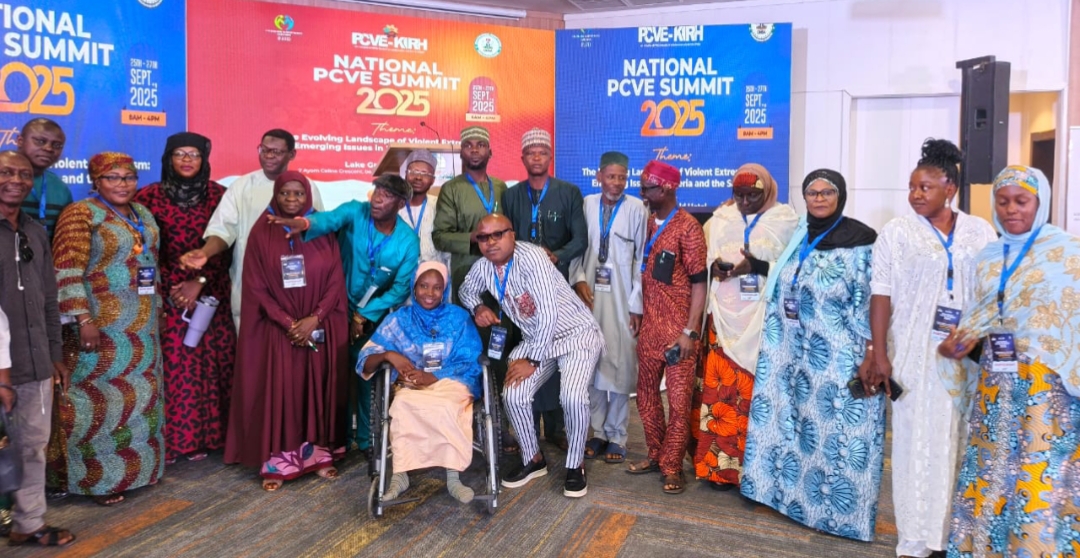
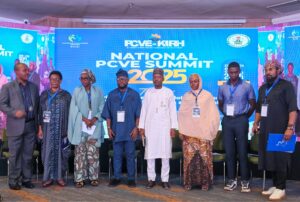
Government officials, civil society leaders, academics, and international development partners have concluded a landmark three-day National Summit on Preventing and Countering Violent Extremism (PCVE) in Abuja, with a unified call for a “whole-of-government, whole-of-society” approach to address the evolving threats of violent extremism in Nigeria and across the Sahel.
Held at the Lake Greenfield Hotel & Towers, the summit was organized by the Preventing and Countering Violent Extremism Knowledge, Innovation and Resource Hub (PCVE-KIRH) in partnership with the National Counter Terrorism Centre (NCTC), Office of the National Security Adviser (ONSA), the Institute for Peace and Conflict Resolution (IPCR) and other key stakeholders. The event received technical support from ActionAid Nigeria and NEYIF, with funding from the Global Community Engagement and Resilience Fund (GCERF).
Themed “The Evolving Landscape of Violent Extremism: Emerging Issues in Nigeria and the Sahel”, the summit aimed to: Review emerging and region-specific extremist threats; Strengthen multi-stakeholder coordination; Promote evidence-based strategies and innovative solutions; Align local and national efforts with Nigeria’s National Action Plan on PCVE and regional frameworks.
Beyond Security: A Development And Governance Challenge

In a series of keynote remarks, speakers emphasized that violent extremism in Nigeria has grown beyond religious radicalism and now intersects with issues of governance failure, inequality, political exclusion, and identity-based conflicts.
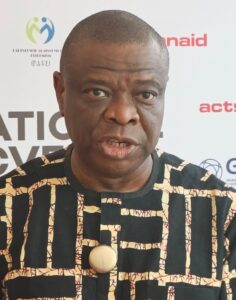
Mr. Jaye Gaskia, Chair of the PCVE-KIRH Steering Committee and the PAVE Network (Partnership Against Violent Extremism), highlighted the evolving nature of extremism: “Violent extremism manifests differently across regions, from Boko Haram in the North-East to separatist agitations in the South-East and communal conflicts in the North-Central. We must stop seeing it purely as a security issue. It is fundamentally a governance and development challenge driven by exclusion, marginalization, and unaddressed grievances.”
He stressed the need to integrate PCVE into state and local development planning, rather than implementing it through isolated, donor-led projects.
Scaling Up Community-Based Solutions

Ms. Yetunde Adegoke, National Coordinator for GCERF, provided deep insight into the summit’s broader objective: “This summit is about scaling up community-based pilot interventions developed since 2016. We’ve reached the stage where we need institutional capacity, not isolated NGOs to drive long-term PCVE efforts. That’s why the PCVE-KIRH and the PAVE Network are central to our exit strategy as donors.”
She explained GCERF’s four strategic levers for building community resilience: Social cohesion, Community agency, Livelihoods and Sense of purpose.
The aim, she said, is to move from donor dependent models to market driven, sustainable approaches, such as fostering social entrepreneurship and linking community cooperatives to private sector markets and impact investors.
Today, the PAVE Network operates in 22 states, with plans to expand to local government levels, fostering a truly national coalition against violent extremism.
Inclusive Engagement, Evidence, and Local Ownership
Across several sessions, participants emphasized the importance of data-driven, context-specific interventions. The PCVE-KIRH aims to establish a national knowledge repository, enabling new actors, including local governments and community groups to access research, case studies, and evidence-based practices.
Mr. Gaskia also called for annual PCVE summits to track implementation of the forthcoming five-year National Action Plan, currently under review and expected to be approved by President Bola Ahmed Tinubu by year’s end.
“We envision a future where each year we gather, evaluate progress, identify gaps, and build on successes. That’s how we create a responsive, evolving national framework,” he said.
Voices from the Field: Women, Youth, and Traditional Leaders at the Frontline
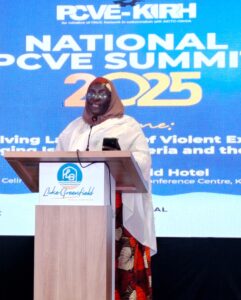
Hajiya Aishatu Abdu Gusau, Coordinator of the PAVE Network in Zamfara State, shared success stories of women and youth as “change agents” in preventing radicalization through non-kinetic strategies such as counseling, interfaith dialogue, and peace education.
“Women are central to peacebuilding. They are not only victims, they are also leaders. Through our interfaith associations and community engagement, we’ve seen mindsets change and resilience grow,” she said.
Traditional and religious leaders also play a vital role in shaping narratives and influencing community behavior, she added.
Military Alone Cannot Win the War, Stakeholders Must Step Up
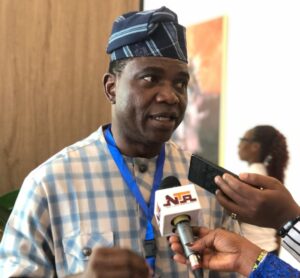
Rtd. Gen. Solomon Babatunde Kumaypayi, Director of Studies at the International Academia for Gender and Peace, criticized the long-standing overreliance on military force to tackle violent extremism.

“For over 15 years, we’ve left the fight to the military. That has to change. This is a societal problem, and it demands a societal response. Sadly, we noticed a lack of participation from legislators at this summit. We must do better.”
He called for enhanced collaboration across all three arms and tiers of government, especially the local governments, which are closest to the people and best positioned to deliver early warning and preventive actions.
Key Outcomes and Recommendations from the Summit: Mainstream PCVE into national and subnational development planning; Establish formal grievance resolution mechanisms at community, local, and state levels; Build capacity of community-based organizations through PCVE-KIRH and PAVE; Promote strategic communications to demystify PCVE and raise public awareness; Support local governments and traditional institutions in early intervention roles; Encourage regular PCVE Summits as national review and accountability platforms; Bridge donor programs with sustainable, community-driven models for resilience.

Participants left the summit with a renewed sense of urgency and collective purpose. As Nigeria navigates the complex landscape of violent extremism, stakeholders agreed that only through inclusive governance, evidence-driven planning, and community-led innovation can real and lasting peace be achieved.

Editor-In-Chief| Global Sentinel
Convener| Geopolitics Series
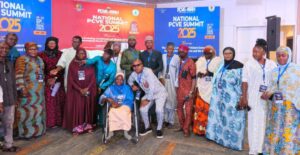
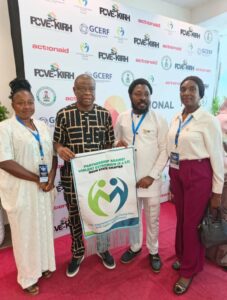
Founder| Initiative for Media Development and Social Impact (IMeDSI) & Media Consultant, PAVE Network and another participant during the summit in Abuja
The summit concluded with commitments to strengthen collaboration, institutionalize best practices, and build a future where peace, resilience, and development are the foundations of national security.