
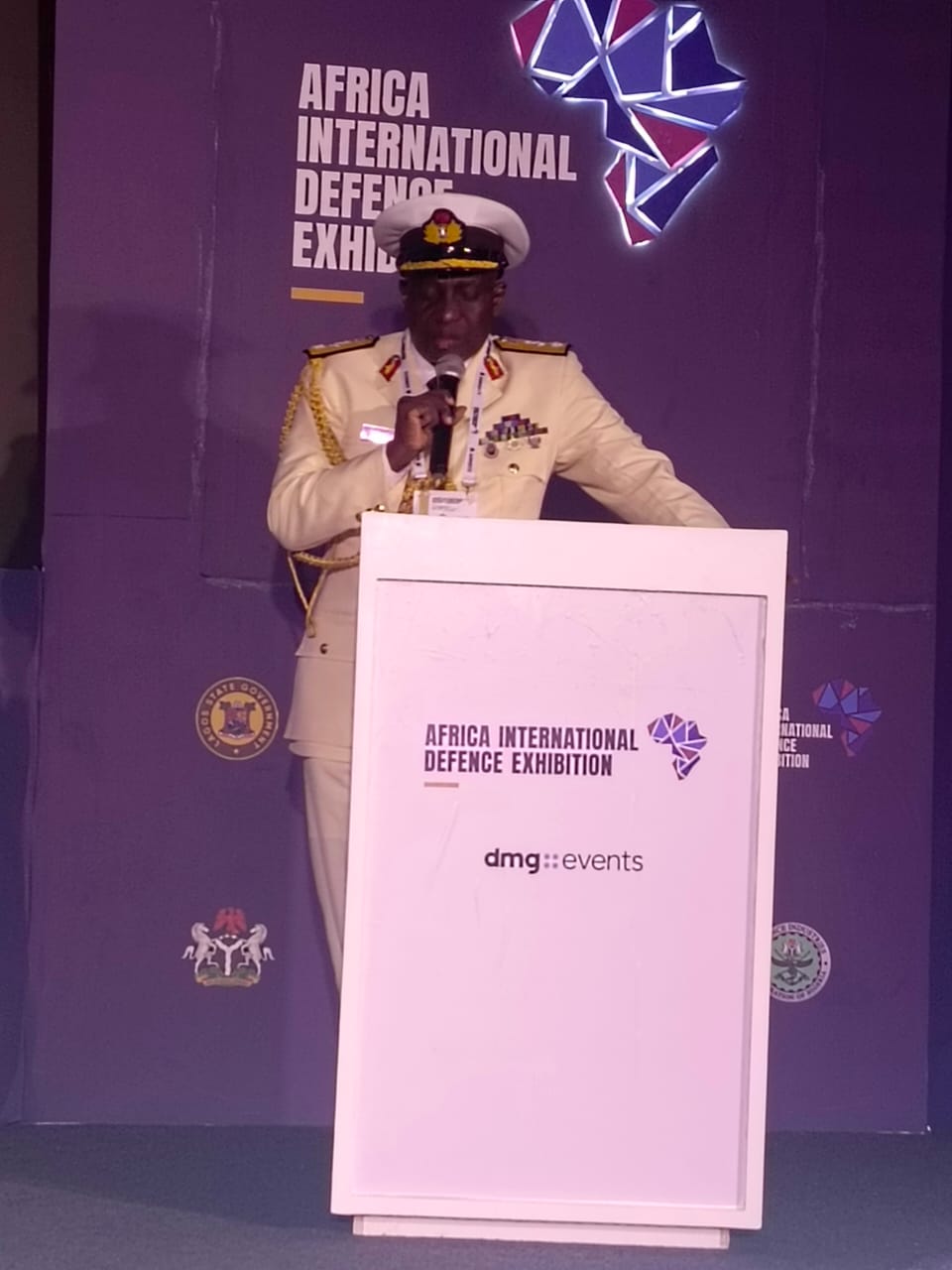
The Nigerian Navy has called for stronger cooperation among maritime security agencies, improved information-sharing and the integration of defence systems to tackle emerging threats in Nigeria’s maritime domain and the wider Gulf of Guinea.
The representative of the Nigerian Navy at the panel discussion session of the 2026 African International Defence Exhibition (AFRIDEX) Commodore Isa Ahmed said effective maritime security depended not only on the acquisition of sophisticated equipment but also on the ability of naval forces, government agencies and regional institutions to work together through compatible systems, common operational standards and coordinated responses.
He made the call while presenting a paper titled “Interoperability at Sea: Strengthening Maritime Security Through Systems, Standards and Integration” at the Africa International Defence Exhibition (AFRIDEX) 2026 in Lagos, saying that the increasing complexity and transnational nature of maritime threats make it imperative for maritime institutions to improve communication, share intelligence and coordinate operations to achieve effective security outcomes.
He explained that interoperability should go beyond connecting surveillance equipment, communications networks and command-and-control systems to ensuring that personnel, institutions and operational procedures function together effectively.
“My central argument today is that interoperability must transform separate maritime capabilities into a coordinated operational advantage,” he said.
Cdre Ahmed identified piracy, armed robbery against ships, maritime trafficking, illegal fishing and the illicit movement of goods as some of the threats exploiting gaps in surveillance, information-sharing and law enforcement across national maritime boundaries.
He noted that a vessel detected by one agency could move into the jurisdiction of another country before the necessary information was shared, potentially undermining efforts to respond promptly.
The commodore stressed that detecting suspicious maritime activity was not enough, adding that information must be properly assessed, transmitted to the appropriate authorities and translated into lawful operational action.
He said Nigeria’s maritime security objectives required reliable surveillance systems, capable platforms, trained personnel and effective command structures, supported by strong cooperation among relevant agencies.
Ahmed identified the Yaoundé Architecture as a critical framework for strengthening regional maritime security cooperation among countries in West and Central Africa.
Established following the 2013 Yaoundé Summit, the framework provides mechanisms for information-sharing, inter-agency cooperation and coordinated responses to piracy, armed robbery against ships and other illicit maritime activities.
He explained that the framework’s effectiveness depended on the ability of participating countries and institutions to exchange timely and accurate information, establish a common understanding of maritime incidents and coordinate their respective responsibilities.
However, he cautioned that the existence of regional coordination centres and information-sharing platforms did not automatically guarantee effective cooperation.
According to him, information must be relevant, sufficiently accurate and available when needed, while national authorities must possess the institutional capacity and operational procedures required to respond appropriately.
The IMION director outlined three essential pillars of maritime interoperability: systems, standards and integration.
On systems interoperability, he advocated connecting existing surveillance and information platforms, including radar, Automatic Identification System data, satellite-based surveillance, vessel-tracking services, intelligence databases and maritime operations centres.
He said combining information from these sources would enable authorised personnel to develop a more comprehensive understanding of maritime activities and make better-informed operational decisions.
Ahmed, however, argued that interoperability did not necessarily require every agency to replace its existing equipment with a single platform.
Rather, he recommended secure interfaces, compatible data-exchange arrangements and agreed procedures that would allow existing capabilities to work together while maximising the value of investments already made.
On standards, he emphasised the need for common technical and operationaljb procedures to ensure that information exchanged between agencies could be consistently understood and acted upon.
He said differences in data formats, terminology, incident-reporting procedures and classification systems could delay responses even when communication equipment was compatible.
He also called for appropriate information-security measures, including access controls and clear rules governing how sensitive information was shared, retained and used.
“The aim is not unrestricted information exchange. It is the secure and appropriate exchange of information with those who have the authority and operational need to receive it,” he stated.
On integration, Ahmed said effective interoperability required clearly defined responsibilities, established liaison arrangements, agreed operating procedures and reliable coordination mechanisms among institutions.
He explained that even when surveillance systems successfully detected suspicious activities and communications networks transmitted the information, the overall response could remain ineffective if the receiving organisation did not know who was responsible for assessing the information or initiating action.
He therefore advocated regular joint exercises, operational simulations and structured reviews of incidents to identify weaknesses and improve coordination among maritime security stakeholders.
Addressing Nigeria’s maritime security environment, Ahmed highlighted the complementary roles of the Nigerian Navy, the Nigerian Maritime Administration and Safety Agency, the Nigerian Ports Authority, law-enforcement agencies and other maritime stakeholders.
He said the agencies had distinct statutory responsibilities but needed to share relevant information and coordinate their activities whenever their mandates intersected.
He urged Nigerian maritime institutions to strengthen information-sharing arrangements, improve inter-agency engagement and ensure that investments in new technology were supported by training, maintenance, cybersecurity and long-term technical support.
According to him, cooperation should not begin only after a security incident has occurred but must be developed and sustained through routine engagements and established operational procedures.
On regional cooperation, Ahmed called for stronger communication between national maritime operations centres, multinational maritime coordination centres and regional institutions across the Gulf of Guinea.
He also identified common operational procedures, personnel development, regular joint exercises and sustainable institutional funding as priorities for improving regional maritime security.
He warned that increased connectivity also presented cybersecurity risks, stressing that the compromise of a system, unauthorised disclosure of sensitive information or the circulation of unreliable data could undermine confidence in regional information-sharing arrangements.
He said cyber security considerations must be incorporated into the design, acquisition, operation and maintenance of interoperable systems.
Ahmed further urged African maritime stakeholders to make interoperability a fundamental requirement in defence procurement rather than an issue to be addressed after equipment had been acquired.
He said procuring authorities should identify operational requirements and specify the systems, information formats, communication interfaces and security arrangements with which new equipment must be compatible.
He added that compatibility should be demonstrated through testing rather than assumed from manufacturers’ claims or the acquisition of similar equipment.
According to him, incorporating interoperability requirements into procurement specifications, contractual obligations and acceptance testing would help reduce avoidable expenditure, prevent duplication and improve the operational value of defence investments.
He stressed that procurement success should be measured not merely by the delivery of equipment but also by its ability to function within the wider operational environment and remain sustainable throughout its service life.
In his recommendations, Ahmed called for stronger connections between national and regional maritime information-sharing arrangements, the adoption of practical interoperability requirements before new systems were acquired, and the integration of compatibility standards into defence procurement.
He also advocated sustained investment in personnel training, institutional coordination, cybersecurity, maintenance and technical support.
The commodore maintained that technology alone could not guarantee maritime security without trained personnel, clear institutional responsibilities and the commitment of participating states to cooperate.
He said progress should be assessed by improvements in maritime awareness, the usefulness of shared information, the quality of operational decisions and the speed and effectiveness of coordinated responses to threats.
Ahmed concluded that stronger interoperability would improve the protection of national interests, secure maritime commerce and contribute to stability across the Gulf of Guinea.
He urged maritime stakeholders to translate regional commitments into practical cooperation, stressing that the ultimate objective was to turn information-sharing into collective awareness and institutional cooperation into coordinated action.