
The General Officer Commanding (GOC), 81 Division, Nigerian Army, Major General Adebayo Babalola, has called for stronger collaboration among security agencies, government institutions and communities to address Nigeria’s evolving security challenges.
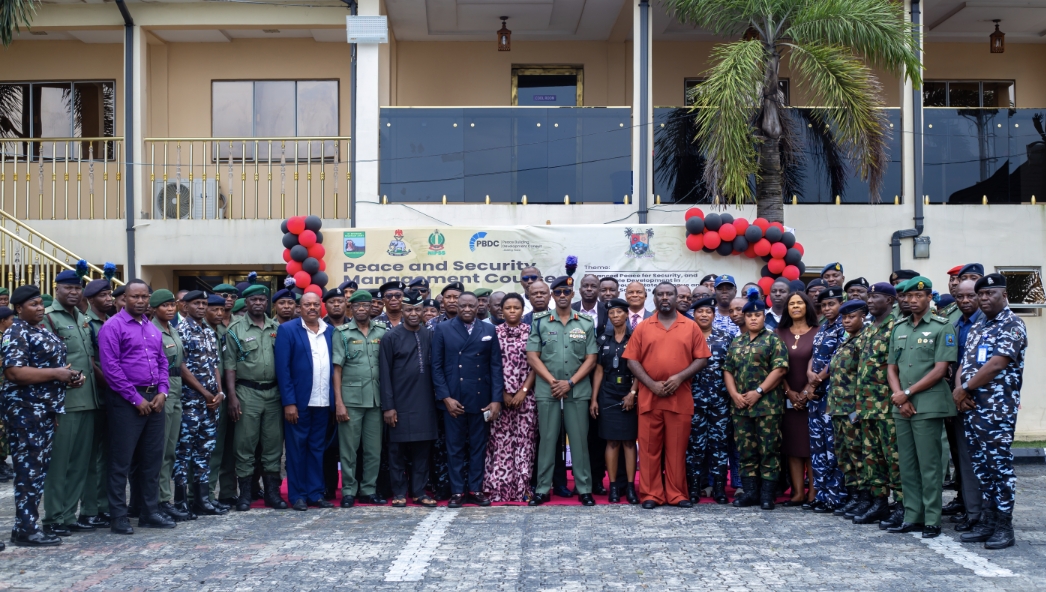
Babalola, represented by the Commander, 55 Signal Brigade, Brigadier General Clement I. Iyere, made the call in his welcome address at the Lagos State Peace and Security Management Course organised by Peace Building Development Consult (PBDC), in partnership with the Nigeria Police Force, National Institute for Policy and Strategic Studies (NIPSS) and 81 Division, Nigerian Army.
The course, with the theme, “Enhanced Peace for Security and Sustainable Development in Nigeria through State Dialogue and Grassroots Solutions,” brought together government officials, policymakers, security and intelligence professionals, traditional and religious leaders, community representatives, women and youth groups, civil society organisations and other stakeholders.
Babalola said the programme was particularly relevant given the increasingly complex nature of insecurity confronting the country, stressing that emerging threats required responses beyond the traditional deployment of force.
He identified kidnapping, cybercrime, cultism, human trafficking, violent extremism, proliferation of small arms, youth restiveness, misinformation and urban violence among the security challenges requiring coordinated and sustainable responses.
According to him, Lagos occupies a strategic position in Nigeria’s security and economic architecture because of its large population, commercial activities, coastal environment and complex urban structure.
He said the state’s unique characteristics made effective interagency coordination, community engagement, intelligence led security management and grassroots interventions essential to maintaining peace and supporting sustainable development.
The GOC said the course provided an important platform for policymakers, security professionals, government officials, community leaders and other stakeholders to examine practical approaches to peacebuilding and security management.
He said participants would deliberate on human and national security, intelligence management, community peacebuilding, interagency collaboration, conflict resolution, cybersecurity, misinformation, crisis management and security sector reform.
Other areas of focus, he added, would include early warning systems, artificial intelligence and the roles of women and youths in peacebuilding, noting that these areas were increasingly important to modern security management.
Babalola stressed that sustainable security could not be achieved by government and security agencies alone, urging stakeholders to promote trust, dialogue, community participation, effective leadership and institutional collaboration.
He encouraged participants to actively engage in the programme, share practical experiences and develop recommendations that could be translated into effective policies and interventions within their institutions and communities.
The GOC, on behalf of PBDC and its partner institutions, expressed appreciation to the participants and other stakeholders for their commitment, urging them to make the deliberations meaningful and outcome driven for the benefit of Lagos State and Nigeria.