
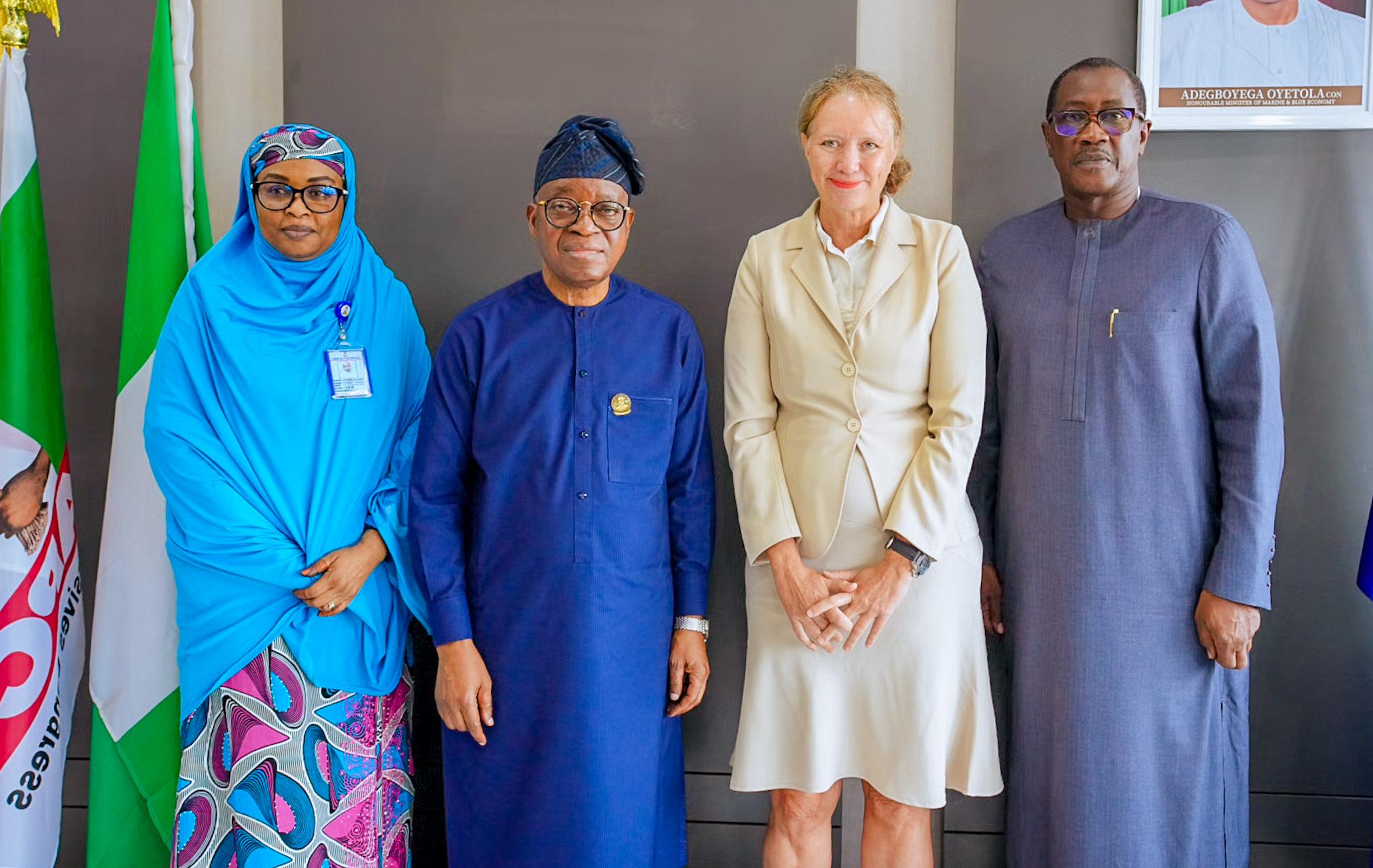
Nigeria’s Minister of Marine and Blue Economy, Dr. Adegboyega Oyetola, has called for a more robust and coordinated role by the European Union in tackling rising maritime threats confronting the Gulf of Guinea.
The minister made the appeal in Abuja while receiving a delegation from the European Union Evaluation Mission on the Gulf of Guinea Inter regional Network Phase Two project, warning that the region’s security landscape is becoming increasingly complex.
He stressed that illegal fishing, human trafficking and environmental crimes continue to undermine economic stability and maritime safety, insisting that only sustained global partnerships can effectively address the growing risks.
The delegation, led by Ms Stéphanie Vergniault, is in Nigeria to conduct an independent assessment of the EU funded initiative aimed at strengthening coordination and information sharing across countries in the Gulf of Guinea.
In a statement issued by his Special Adviser, Dr. Bolaji Akinola, the minister reaffirmed Nigeria’s commitment to the Yaoundé maritime security framework, describing it as a cornerstone for collective response and intelligence driven cooperation in the region.
Oyetola noted that EU supported programmes such as the GoGIN initiative have significantly enhanced maritime domain awareness and fostered stronger collaboration among national and regional institutions.
He also acknowledged the strategic value of the YARIS information sharing platform, which he said has improved operational coordination among maritime stakeholders, while calling for its continuous optimisation and wider adoption.
The minister emphasised the need to deepen interoperability between regional coordination centres and national agencies, alongside sustained technical assistance and capacity development to consolidate existing gains.
Highlighting Nigeria’s domestic strides, Oyetola pointed to the Deep Blue Project, which he said has played a decisive role in reducing piracy and sea robbery incidents, demonstrating the impact of aligning national initiatives with international support.
As the current phase of the GoGIN programme approaches completion, he urged stakeholders to prioritise sustainability and stronger regional ownership to preserve progress and prevent a relapse into insecurity.
Earlier, Vergniault explained that the mission is evaluating the programme’s outcomes, efficiency and long term viability, while drawing lessons to guide future interventions in maritime security across the Gulf of Guinea.