
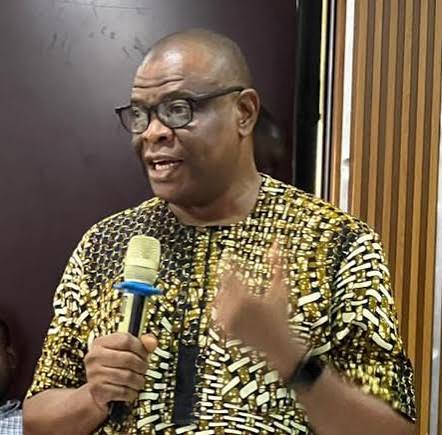
At the HOMEF School of Ecology in Port Harcourt, social justice advocate and governance expert Mr. Jaye Gaskia delivered a powerful presentation titled “Sacrificed and Discounted, The Scourge of Extraction in a Neocolonial State.”
Gaskia’s paper dissected the enduring links between environmental exploitation, the extractive economy, and neocolonial political systems, while calling for a transformative global movement to reclaim ecological and social justice.
According to Mr. Gaskia, “environmental sacrifice zones” are places where economic and industrial interests are prioritized above human and ecological wellbeing.
He explained that oil-producing areas like the Niger Delta and mining zones in Plateau and Zamfara are clear examples of how entire communities have been “sacrificed and discounted” for profit.
“These are communities where pollution, displacement, and poverty are the price paid for development that benefits others,” he said. “The people bear the brunt of an extractive system that was never designed for their wellbeing.”
Gaskia traced the roots of this exploitation to the colonial project, which, he said, “was fundamentally extractive in purpose.”
“The neocolonial state,” he explained, “is merely a reconfigured colonial state pacifying, exploitative, and subservient to global capital.”
He argued that extraction and neocolonialism are mutually reinforcing: one feeds the other, perpetuating inequality, dependency, and ecological devastation.
The “sacrificed and discounted,” according to Gaskia, include both primary victims, communities directly hosting extractive projects and secondary victims, whose air, rivers, and farmlands suffer pollution from afar.
He noted that these victims are not only casualties of corporate greed but also of state complicity.
“The neocolonial state acts as the enabler of extraction,” he said. “It extracts from the many to enrich the few.”
Gaskia challenged the notion that a neocolonial state or the current global economic order can lead a “just recovery.”
“For sacrifice zones to be recovered,” he said, “we must radically restructure global capitalism, deconstruct neocolonial governance, and design a new model of coexistence with nature.”
He outlined key components of this recovery: Environmental remediation of polluted zones; Health interventions for affected populations; Socioeconomic empowerment through new livelihoods; and Equitable access to a clean environment.
However, Gaskia warned that “a green economy driven by the same exploitative logic cannot be just or sustainable.”
He emphasized that real transformation must begin with community sovereignty and self-governance: “Natural resources are community resources. Therefore, managing them must be rooted in community institutions and local accountability.”
He called for inclusive governance that recognizes communities not as victims but as key actors in decision-making and recovery efforts.
Concluding his paper, Gaskia called for a global political movement, one that unites organized communities, extraction workers, and citizens’ groups to challenge the exploitative global order.
“To end sacrifice zones, we must end the extractive model itself,” he declared. “Recovering the environment means transforming the state, the economy, and the way we relate to nature.”
He proposed a tripartite global alliance dedicated to equity, social justice, and ecological restoration, a new world order grounded in solidarity rather than subjugation.