
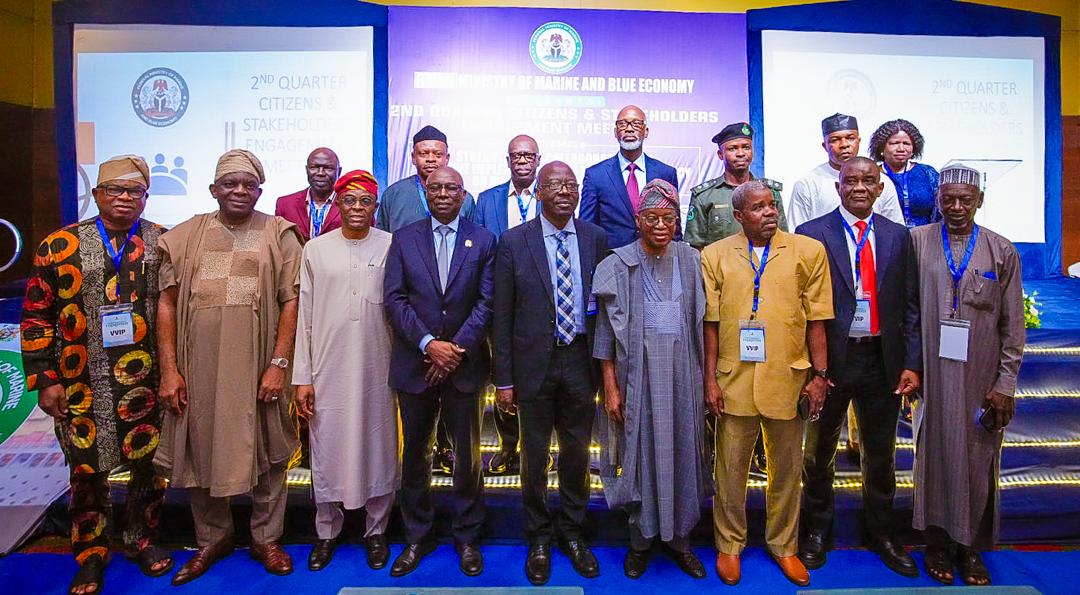
The Federal Government has commenced a strategic rollout of port rehabilitation and shipping reforms as part of efforts to implement the newly approved National Policy on Marine and Blue Economy.
This was revealed by the Minister of Marine and Blue Economy, Adegboyega Oyetola, at the Citizen/Stakeholders Forum held on Thursday, July 3, 2025, at Eko Hotels and Suites, Victoria Island, Lagos. The forum, attended by government officials, maritime stakeholders, civil society actors, and industry leaders, focused on aligning implementation strategies for the new policy framework.
In his keynote address, Oyetola described the National Policy on Marine and Blue Economy as a transformative document aimed at unlocking value across Nigeria’s maritime ecosystem through investments in port infrastructure, indigenous shipping, aquaculture, ocean governance, marine biotechnology, renewable energy, and coastal tourism.
“The approval of this policy by the Federal Executive Council is a turning point for our sector. Our task now is to drive implementation with clarity, urgency, and collaboration,” the Minister said.
He announced that the Federal Government had approved contracts for the full reconstruction of the Apapa and Tin Can Ports under the Western Port Rehabilitation Programme, while procurement is underway for the Eastern Ports. These infrastructural upgrades, he noted, are complemented by digital innovations such as the Port Community System, the E-Call-Up System, and a One-Stop-Shop clearance platform—all designed to eliminate delays and improve efficiency at Nigerian ports.
On shipping development, Oyetola disclosed that plans were underway to revive a national carrier through a public-private partnership model. He also confirmed that the Nigerian Maritime Administration and Safety Agency (NIMASA) had begun preparatory work for the disbursement of the long-awaited Cabotage Vessel Financing Fund (CVFF). He assured stakeholders that the process would be transparent and regulatory-compliant.
“Building indigenous shipping capacity is critical to our goal of positioning Nigeria as the maritime hub for West and Central Africa,” he added.
Highlighting performance metrics, the Minister revealed that the Ministry achieved a 75 percent score in the 2024 performance evaluation by the Office of the Special Adviser to the President on Policy and Coordination, placing it among the top-performing Ministries, Departments and Agencies (MDAs).
He outlined other key areas of progress, including increased digitisation, enhanced revenue collection across maritime agencies, and the removal of regulatory bottlenecks to ease trade facilitation. Investment is also being encouraged in dry ports, bonded terminals, inland logistics corridors, and warehousing infrastructure.
Oyetola further highlighted Nigeria’s regional leadership role, disclosing that the country is spearheading the establishment of the Regional Maritime Development Bank under the Maritime Organisation of West and Central Africa (MOWCA), with headquarters already secured in Abuja.
On inland waterways, he said the Ministry—through the National Inland Waterways Authority (NIWA)—has deployed ferries, patrol boats, and distributed over 42,000 life jackets nationwide. These efforts, he said, have contributed to a noticeable decline in water transport accidents.
With the transfer of the Department of Fisheries and Aquaculture to his Ministry, Oyetola pledged to scale up investments in fishery terminals, licensing automation, and aquaculture, to enhance food security and rural livelihoods.
On maritime security, the Minister stated that Nigeria had sustained zero piracy incidents for three consecutive years under the Deep Blue Project. He added that the African Union has endorsed Nigeria’s bid to host the Combined Maritime Task Force in Lagos.
He also disclosed that Nigeria has officially launched a bid to secure a Category “C” seat on the International Maritime Organisation (IMO) Council later this year, a move aimed at enhancing the country’s voice in global maritime governance.
“Our transition to a sustainable blue economy will not happen automatically. It will take innovation, investment, and strong partnerships,” Oyetola emphasized, urging stakeholders to collaborate and contribute meaningfully to the ongoing implementation process.
He thanked industry players, academia, development partners, and policy actors present, and reaffirmed the Ministry’s commitment to creating enabling policies and institutional linkages that will boost maritime growth and national development.