
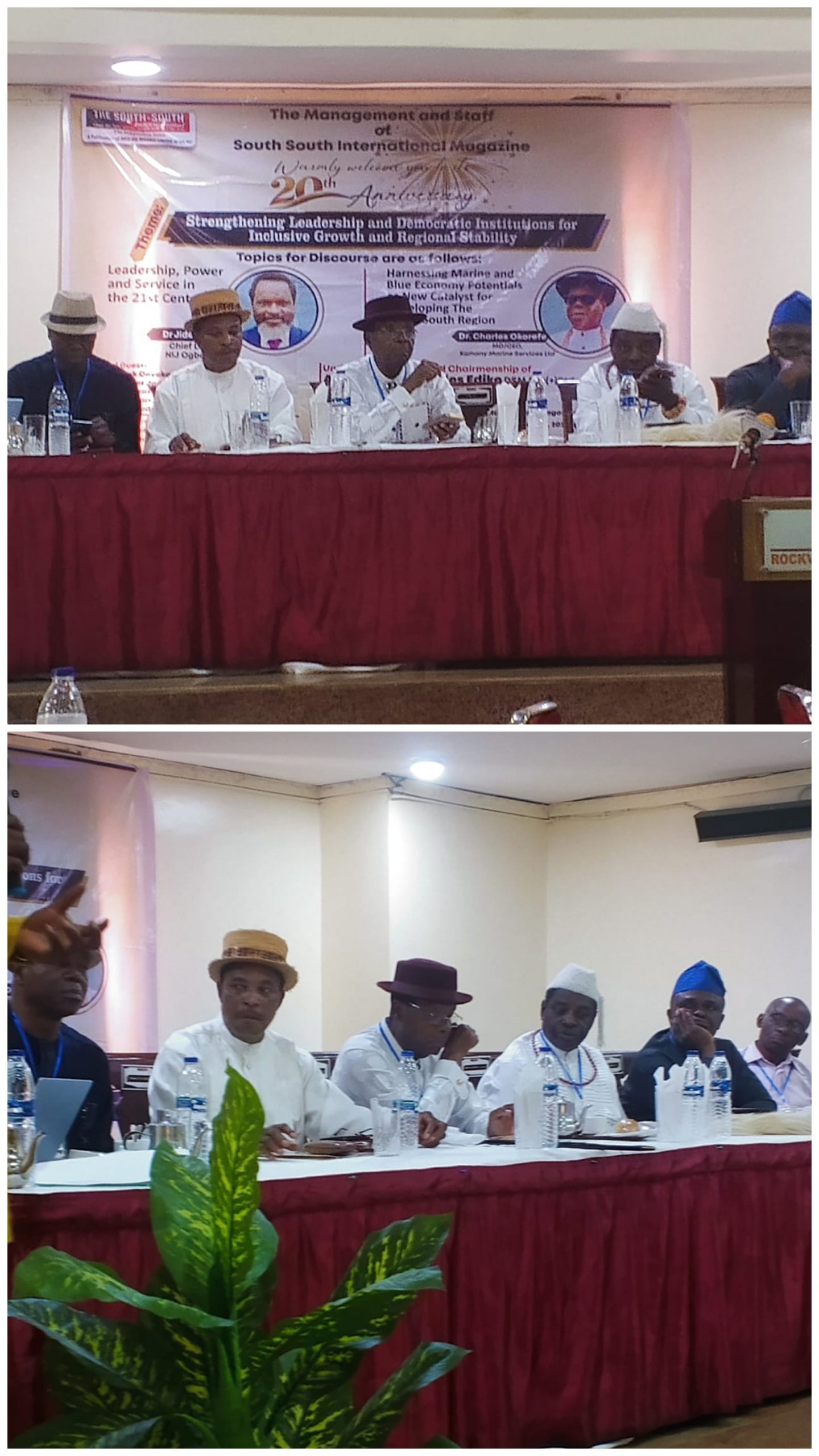
The 20th anniversary of South-South International Magazine has provided a platform for prominent media practitioners, academics and industry leaders to call for accountable leadership, stronger democratic institutions and increased investment in the Blue Economy as pathways to sustainable development in the Niger Delta.
At the anniversary public lecture held at Rockview Hotel, Apapa, Lagos, speakers stressed the need for political leaders to translate public authority into effective service delivery, strengthen governance structures and explore the economic opportunities offered by the region’s marine resources.
Former Independent National Electoral Commission (INEC) Electoral Commissioner, Mike Igini, who co-chaired the anniversary celebration, described the magazine’s 20-year journey as a remarkable achievement in Nigeria’s challenging media environment.
In his opening remarks, Igini commended the management, editorial board and Chief Host, Dr. Ovie Edomi, for sustaining the publication over two decades, noting that its commitment to informing the public and promoting the South South remained worthy of recognition.
He said the anniversary theme, Strengthening Leadership and Democratic Institutions for Inclusive Growth and Regional Stability, reflected the urgent need for accountable leadership and institutions capable of delivering tangible benefits to Nigerians.
Igini, drawing from his experience in electoral administration, maintained that democratic institutions were not defined by their physical structures but by the values they uphold, the rules they enforce and the character of those entrusted with their responsibilities.
He warned that weak leadership and ineffective institutions would continue to undermine development, adding that ordinary Nigerians, particularly residents of oil producing communities, traders, students and vulnerable households, often bear the consequences of governance failures.
The former INEC commissioner urged participants to use the anniversary to promote constructive discussions, demand responsible leadership and advance an inclusive development agenda that benefits all sections of society.
Delivering a public lecture titled Leadership, Power and Service in the 21st Century, the Chief Lecturer of the Nigerian Institute of Journalism (NIJ), Ogba, Lagos, Jide Johnson, PhD, said elections alone could not guarantee effective democracy or good governance.
Johnson argued that Nigeria’s democratic progress should be measured not merely by the conduct of periodic elections but by the ability of elected leaders to protect citizens’ rights, improve public services and ensure accountability in the management of public resources.
Referring to Sections 14(2)(a) and 14(2)(b) of the 1999 Constitution, he stressed that sovereignty belonged to the Nigerian people and that their security and welfare remained the primary purpose of government. He described public office as a position of trust, not private property or family inheritance.
The NIJ lecturer examined transformational, servant and democratic leadership, drawing on the works of James MacGregor Burns, Bernard Bass and Robert Greenleaf. He advocated a shift from personality driven politics to impartial, predictable and law governed institutions, with transparency, accountability and public value guiding government performance.
Also speaking, the Managing Director and Chief Executive Officer of Kamany Marine Services Limited, Dr. Charles Okorefe, called on governors in the South South to prioritise the development of the marine and Blue Economy to diversify regional economies, create employment and reduce dependence on crude oil.
Presenting a paper titled Harnessing Marine and Blue Economy Potentials as New Catalyst for Developing the South South Region of Nigeria, Okorefe described the Blue Economy as a sustainable development model that creates economic opportunities from oceans, seas, rivers, lakes and coastal resources while protecting aquatic ecosystems.
He identified fisheries, aquaculture, maritime transportation, shipping, port operations, coastal tourism, renewable energy, marine biotechnology, dredging and inland waterways transportation as sectors capable of transforming the region’s economic fortunes. He also highlighted the historical commercial importance of coastal centres such as Calabar, Opobo, Brass, Burutu and Warri, before tracing the region’s oil industry to the discovery of commercial crude oil at Oloibiri in 1956.
However, Okorefe warned that decades of oil exploration had contributed to environmental degradation, communal tensions and economic challenges across the Niger Delta. He called for deliberate diversification into marine based industries, supported by improved infrastructure, stronger environmental regulations, professional training and community participation.
To unlock the region’s potential, he recommended that South South governors develop a regional Blue Economy investment blueprint, establish aquaculture and fish port clusters, promote public private partnerships and explore Blue Bonds to finance marine conservation. Citing Seychelles’ $15 million Blue Bond initiative, he urged governments to invest in mangrove protection, marine technology, renewable energy and integrated transportation infrastructure.
The anniversary celebration also featured distinguished personalities, including ACG Eporwei Charles Edike (rtd), ACG Frank Onyeka, Comptroller Joe Anani, Olorogun Barr. Fred Majemite and Olorogun Dudu Akpotor. Speakers included Mr. Sam Omatseye, Chairman of The Nation Editorial Board, and Prof. Mrs. Beauty Alloh, Dean of the Faculty of Law, Delta State University, Oleh Campus.
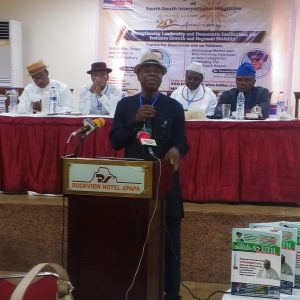
The event reaffirmed the importance of responsible journalism, institutional accountability and regional economic cooperation in advancing Nigeria’s democratic and development aspirations.