
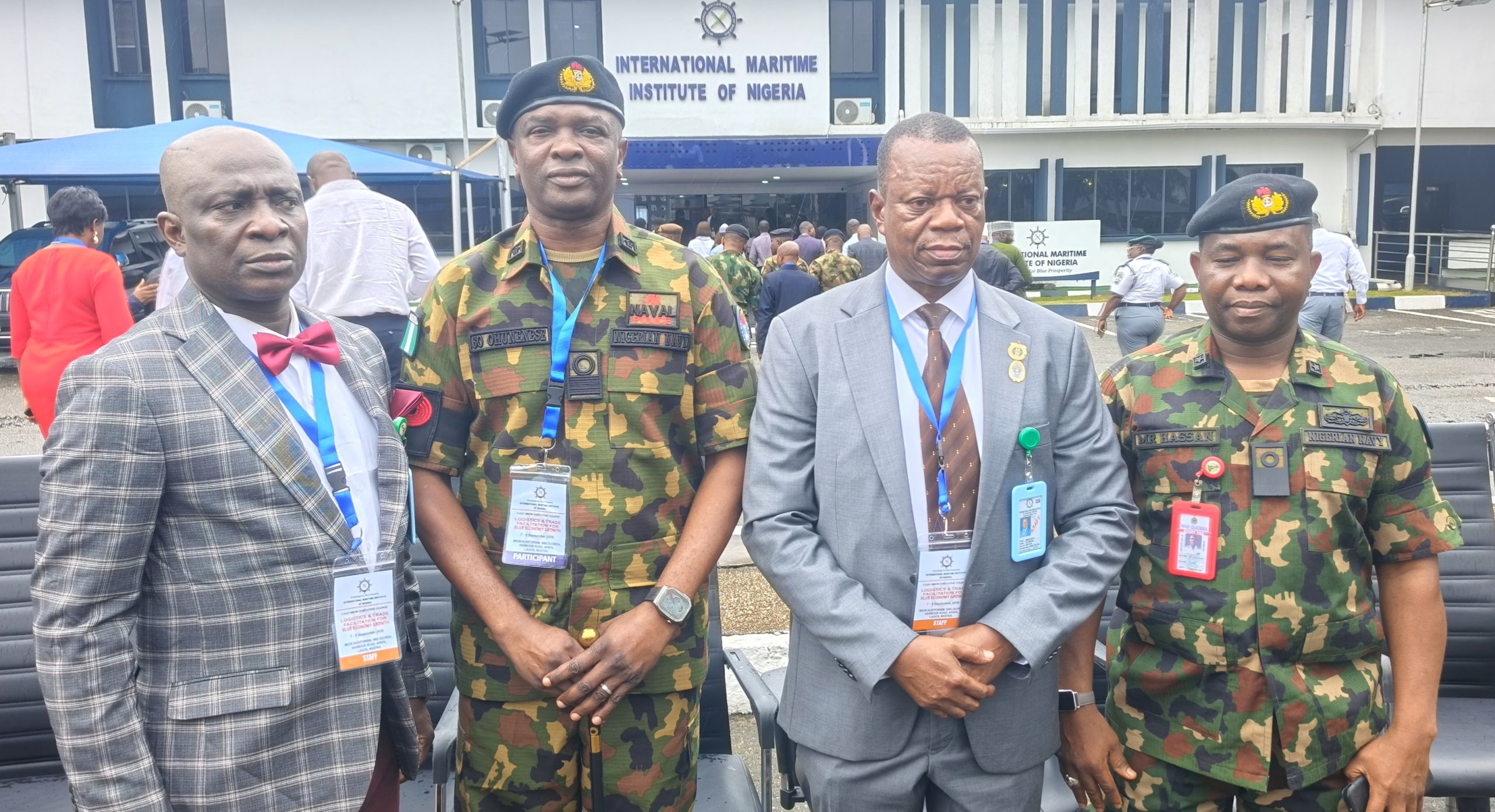
The International Maritime Institute of Nigeria (IMION) has called for far-reaching reforms in logistics and trade facilitation to reduce cargo delays, lower transaction costs and unlock the full economic potential of Nigeria’s blue economy.
The institute made the call during a three-day Executive Programme on “Logistics and Trade Facilitation for Blue Economy Growth”, which brought together senior maritime professionals, government officials, regulators, operators and other stakeholders in Lagos.
The programme, held at the IMION Auditorium, NNS QUORRA, Apapa Road, Lagos, focused on practical solutions to persistent challenges affecting cargo movement, port operations, Customs processes, supply chains and Nigeria’s maritime competitiveness.
Declaring the programme open, IMION Director General, Rear Admiral Thaddeus Udofia (rtd), said efficient logistics remained fundamental to converting Nigeria’s vast maritime resources into sustainable economic opportunities.
Udofia said the blue economy could support economic growth, employment, trade expansion and regional integration if Nigeria developed the capacity to move goods, people, information and services efficiently across its maritime corridors.
He noted that Nigeria’s maritime domain, including its coastline, Exclusive Economic Zone, inland waterways, creeks, estuaries and the Niger Delta Basin, contained enormous living and non-living resources.
The IMION DG, however, stressed that natural resources alone could not guarantee prosperity without efficient infrastructure, logistics systems, trade processes and coordinated institutions.
“Logistics is the backbone of the maritime industry. The blue economy is a trade driven economy,” Udofia said, noting the dominant role of sea transport in global trade.
He said persistent inefficiencies in logistics would continue to limit the capacity of Nigeria’s blue economy to generate greater value, create jobs and strengthen the country’s position in regional and international trade.
According to him, the executive programme was designed to equip participants with practical knowledge and tools for tackling bottlenecks affecting the movement of cargo and services across the maritime value chain.
He called for stronger collaboration among the Nigeria Customs Service, port authorities, regulators, shipping companies, freight forwarders, transport operators, technology providers and financial institutions.
Udofia said Nigeria could no longer afford institutional silos, stressing that digitalisation, transparency, interoperability, data sharing and effective policy implementation were essential to building a competitive maritime economy.
Speaking on logistics and the foundation of the blue economy, the Dean, School of Transport and Logistics, Lagos State University, Prof. Ogochukwu Ugboma, said logistics was the mechanism through which different components of the blue economy were converted into economic value.
Ugboma explained that the blue economy went beyond maritime trade to include coastal resources, tourism and other activities whose success depended on the efficient movement of cargo, people, information and financial resources.
She cautioned against treating logistics merely as the physical movement of goods, saying an efficient supply chain also required seamless information and financial flows.
Ugboma said improving operations within individual port terminals would not be enough to resolve cargo evacuation challenges unless the wider connection between the ports and the hinterland was also addressed.
She identified functional access roads, improved gate turnaround times and efficient connections to inland destinations as critical components of a seamless port logistics system.
Also speaking, the Founder and Chief Executive Officer of Supply Chain War Room and Director General of the African Centre for Supply Chain, Dr Obiora Madu, said Nigeria was losing significant economic value through inefficiencies within its port and logistics systems.
Madu urged policymakers to begin viewing ports as economic corridors rather than mere gateways, arguing that the true efficiency of a port depended largely on the strength of its connection with the hinterland.
He said congestion, delays and other inefficiencies increased the cost of imports, with the additional burden eventually passed to consumers, while urging sustained research into Nigeria’s performance on the World Bank Logistics Performance Index.
The programme culminated in capstone presentations by participants, with Group One proposing a One Coordinated Port to Hinterland System to address cargo delays, congestion, repeated inspections, poor information sharing and unpredictable truck scheduling.
Presenting the Group One project, titled “Building a Faster, Smarter and More Coordinated Cargo Movement System in Nigeria,” Mr Patrick Ocheme Michael of the Association of Maritime Reefer Truck Owners, alongside other team members, said Nigeria needed to treat cargo movement as one integrated system.
The group proposed a single cargo movement plan, smart truck appointment scheduling, shared digital information, risk-based inspection, inland destination readiness and a real-time performance dashboard, alongside greater use of rail and inland waterways.
It said the proposed system should be measured through indicators including truck turnaround time, cargo dwell time, delivery lead time, schedule reliability, logistics costs, digital transaction rates, safety and security incidents, and the proportion of cargo moved by rail or barge.
The group recommended a phased implementation beginning with a 90-day diagnostic and stabilisation period, followed by pilot automation and training, integration in subsequent years and broader adoption of smart port systems within five years.
At the closing ceremony, Udofia said the programme had demonstrated that developing Nigeria’s blue economy required collective action across government agencies, private operators, regulators, security institutions and other stakeholders.
He also highlighted inadequate cold-chain infrastructure as a major constraint to the growth of fisheries and aquaculture, while calling for stronger multimodal transport connections linking maritime, road, rail and inland waterway systems.
A member of the Governing Board of IMION, Rear Admiral Akin Johnson (rtd), described the programme as a valuable platform for addressing the complex challenges confronting maritime logistics and trade facilitation.
Johnson urged participants to return to their organisations with the determination to apply the knowledge gained, stressing that political will, institutional commitment and the right organisational culture were critical to sustaining reforms.
Speaking virtually, IMION consultant, Barrister Mfon Usoro, said the programme was structured around practical industry challenges rather than purely academic instruction.
Usoro disclosed that IMION was engaging the Admiralty University of Nigeria and other institutions on partnerships aimed at strengthening the recognition and professional value of certificates issued through the institute’s executive programmes.
The capstone presentations were assessed by a panel of judges, with Group One emerging first with 245 points, followed by Group Two with 236 points, Group Four with 214 points and Group Three with 190 points.
The winning team comprised Commodore S.O. Ohunenese, Olivia Fatima Anyaegbunam, Patrick Ocheme Michael, Captain U.Y. Tukur, Francis Odiari, Adekitan Talabi, Jessica Jonathan, Osahon Omonjiade, Victor Enebeli, Jamiu Balogun and Ogechukwu Ifeme.
In his vote of thanks, Chairman of EMSEE Shipping Line Limited, Mr Victor Enebeli, who spoke on behalf of the winning team and other participants, expressed appreciation to IMION, its facilitators and supporting institutions for the training.
Udofia also appreciated the Chief of the Naval Staff, Vice Admiral Idi Abbas, for his support for IMION and participation of Nigerian Navy officers in the programme, as well as the institute’s governing board, consultants and resource persons.
The IMION DG unveiled the second edition of the IMION Newsletter, describing it as a platform for documenting developments, innovations and emerging issues within Nigeria’s maritime industry and the wider Gulf of Guinea.
He said the ultimate test of the programme would not be the certificates presented to participants but the practical improvements they would introduce in their respective organisations.
The institute reaffirmed its commitment to research, professional capacity development and policy advocacy, with the objective of supporting a more efficient, digitally connected, competitive and sustainable maritime sector in Nigeria and Africa.