

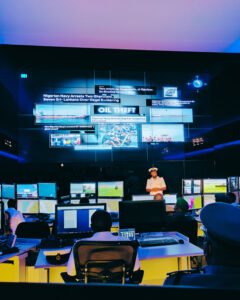
As the Nigerian Navy celebrates its 70th anniversary, RTCOM Defense has described the Falcon Eye Maritime Surveillance System as the technological backbone that transformed Nigeria’s maritime security from reactive patrols to intelligence driven operations.
The company’s CEO Mr. Gerard Levy said Falcon Eye has fundamentally changed maritime domain awareness by providing real time surveillance across Nigeria’s coastline, enabling security agencies to detect, track and respond rapidly to threats before they escalate.
RTCOM Defense explained that the integrated platform combines over the horizon radar, coastal radar stations, electro optical and infrared sensors, Automatic Identification System data and other intelligence assets into a unified operational picture covering about 850 kilometres of coastline and more than 200,000 square kilometres of territorial waters extending 200 nautical miles offshore.
According to Gerard Levy, the system has significantly reduced the time required to detect and intercept criminal activities at sea, compressing operational response from several hours to only a few minutes through real time intelligence processing.
He noted that following Falcon Eye’s full commissioning in July 2021, Nigeria recorded zero piracy incidents in its territorial waters before the end of the year, a development recognised by the International Maritime Bureau. The company also linked the achievement to Nigeria’s removal from the global piracy risk list and the reported 80 per cent reduction in war risk insurance premiums for commercial shipping.
Responding to recurring claims that the Falcon Eye platform belongs to the Deep Blue Project, RTCOM Defense dismissed the assertion, insisting that it conceived, designed, engineered, integrated and has continued to operate the surveillance system since receiving the federal contract in 2014.
Levy explained that the project was originally awarded by the Office of the National Security Adviser, while the Nigerian Navy remains the principal operational user. Other agencies, including NIMASA, the Nigerian National Petroleum Company Limited, the Nigerian Ports Authority and the Nigeria Customs Service, also utilise dedicated workstations within the command centre.

CEO
RTCOM Defense
RTCOM Defense maintained that Falcon Eye and the Deep Blue Project are entirely separate government initiatives with distinct mandates. While Deep Blue focuses on response assets such as vessels, aircraft and tactical equipment, Falcon Eye serves as the intelligence and surveillance platform that provides comprehensive maritime domain awareness.
Clarifying ownership, Gerard Levy said Falcon Eye’s infrastructure, engineering architecture and technical operations remain under RTCOM Defense through a long term support arrangement, while the Nigerian Navy continues to rely on the platform for operational planning and coordinated maritime security missions.
The company attributed public misunderstanding over Falcon Eye’s ownership to the visibility of the Deep Blue Project, whose operational assets attracted widespread public attention. It argued that references to Falcon Eye as an intelligence input for Deep Blue gradually created the false impression that both projects were one and the same.
RTCOM Defense stressed that correcting the narrative is essential to preserve accountability, procurement transparency and informed national security planning, particularly regarding future investments in surveillance infrastructure and defence technology.
Highlighting Falcon Eye’s operational impact, the company stated that the system has supported the interception of hundreds of illegal maritime activities, including piracy, crude oil theft, illegal bunkering, smuggling and illegal fishing, while serving as a strong deterrent against organised maritime crime across Nigeria’s waters.
Looking ahead, RTCOM Defense disclosed that Falcon Eye is entering a new phase powered by artificial intelligence. The planned upgrades will include intelligent sensor fusion, automated anomaly detection, behavioural analysis, predictive threat assessment and enhanced decision support designed to improve operational effectiveness without replacing human operators.
Beyond maritime surveillance, the company revealed plans for Hawk Eye to strengthen security across Nigeria’s inland waterways, oil facilities and critical energy infrastructure, while Eagle Eye is being developed as a land based intelligence platform to support efforts against terrorism and banditry, subject to government approval.

RTCOM Defense reaffirmed its commitment to strengthening its long standing partnership with the Nigerian Navy, expressing confidence that the next generation of Falcon Eye and its complementary platforms will consolidate Nigeria’s leadership in maritime security, safeguard national economic assets and provide an integrated intelligence architecture covering the sea, inland waterways and land domains.