
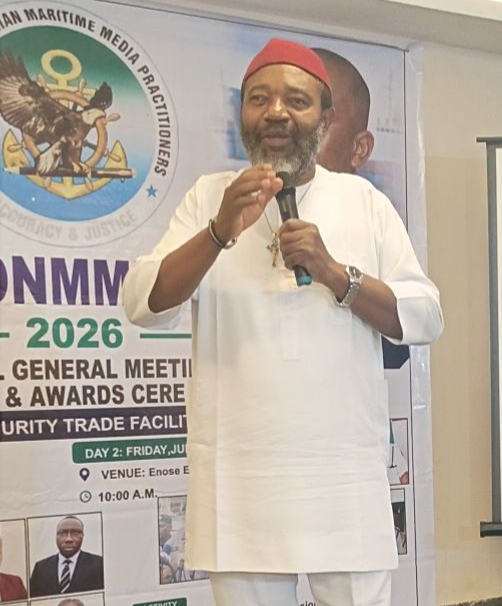
The maritime media has been challenged to move beyond routine event reporting and embrace investigative journalism as a critical weapon against smuggling, maritime crime and trade related corruption across Nigeria’s maritime sector.
The charge was delivered by the keynote speaker, Forwarder Eugene Nweke, PFF, at the opening of the Congress of Nigerian Maritime Media Practitioners (CONMMEP) Annual Lecture and Awards, where he declared that the media must become an active partner in safeguarding the nation’s economy and maritime domain.
Speaking on the theme, Maritime Security, Trade Facilitation and the Media, Nweke described silence as the greatest enabler of smuggling, warning that criminal networks thrive whenever citizens, institutions and journalists fail to expose suspicious activities.
“The greatest weapon of smuggling is silence. Smuggling succeeds when people see something and say nothing,” he declared, urging journalists to see investigative reporting as a frontline national security responsibility rather than a professional option.
He explained that smuggling has evolved beyond the illegal movement of goods into highly organised transnational crimes, including arms trafficking, narcotics smuggling, human trafficking, counterfeit products, wildlife trafficking, fuel diversion, revenue evasion and trade based money laundering.
According to him, the growing sophistication of these criminal enterprises means that security agencies alone cannot win the battle, stressing that success requires a coordinated whole of government and whole of society approach in which the media serves as a strategic force.
Nweke said the press must strengthen intelligence driven journalism by gathering credible information, raising public awareness and promoting accountability, adding that responsible reporting can prevent crime before it occurs and reinforce national security objectives.
He challenged maritime journalists to intensify investigations into budget implementation across maritime agencies by tracking approved allocations, releases, project execution and abandoned contracts to ensure greater transparency in public spending.
The maritime expert also urged the media to scrutinise procurement processes by examining contract awards, compliance with procurement laws, project costs, beneficiaries and whether completed projects meet approved specifications and deliver value for public funds.
He further called for sustained investigations into shipping costs and terminal charges, asking journalists to interrogate how such charges are determined, whether they comply with international standards and the extent of their impact on Nigeria’s trade competitiveness and economic growth.
Nweke also identified cargo diversion, illegal bunkering, piracy in the Gulf of Guinea and other emerging maritime threats as areas requiring deeper investigative reporting to expose regulatory loopholes, criminal networks, financial beneficiaries and the effectiveness of security interventions.
To strengthen the fight against smuggling, he urged journalists to embrace investigative reporting, sustain public enlightenment campaigns, encourage voluntary compliance with trade regulations, responsibly share credible intelligence within ethical limits and actively counter misinformation that often protects organised criminal groups.
While encouraging collaboration with security agencies, he cautioned journalists against compromising their independence, insisting that professionalism, factual accuracy and ethical reporting remain essential to maintaining public trust and credibility.
He reminded media practitioners that although they are neither regulators nor enforcement officers, their reports shape public opinion, influence government policies and strengthen accountability, stressing that the future of maritime security depends partly on the quality of journalism produced by the sector.
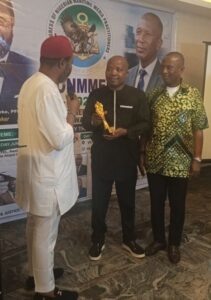
The lecture was followed by the CONMMEP Awards, where distinguished personalities were recognised for advancing maritime security, trade facilitation and national economic development. Among the recipients was retired Assistant Comptroller General of Customs, A.B. Shuaibu, who received the CONMMEP Evergreen Leadership Excellence Award for his outstanding contributions to border security, anti smuggling operations, revenue protection, inter agency collaboration and stakeholder engagement during his years of public service.