
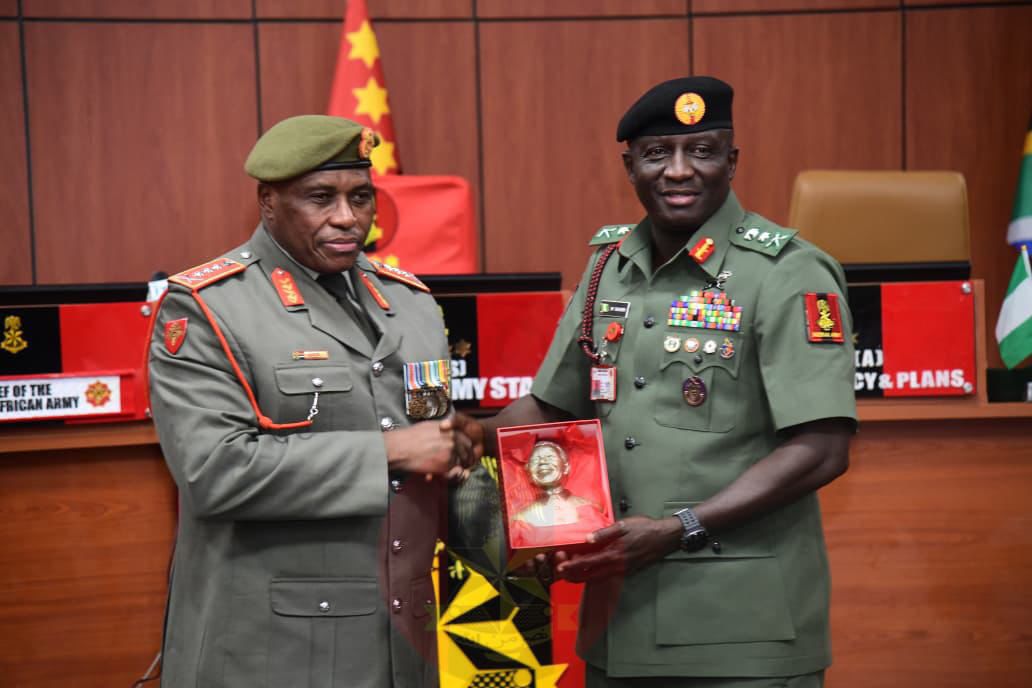
The Nigerian Army has reaffirmed its commitment to strengthening military cooperation with the South African Army as part of broader efforts to confront emerging security threats across the African continent.
Chief of Army Staff, Lieutenant General Waidi Shaibu, made the declaration while receiving the Chief of the South African Army, Lieutenant General Lawrence Khulekani Mbatha, during an official working visit to the Army Headquarters in Abuja.
Shaibu noted that closer collaboration among African militaries had become imperative in the face of increasingly complex and evolving security threats confronting the continent.
He stressed that enhanced cooperation in training and operational exchanges would play a crucial role in improving the capacity of African armed forces to tackle terrorism, insurgency and other asymmetric threats.
The army chief particularly highlighted Nigeria’s ongoing counter-terrorism operations in the North-East under Operation HADIN KAI, noting that lessons from the theatre continue to shape the Nigerian Army’s operational doctrine and training programmes.
According to him, the Nigerian Army has intensified specialised training aimed at preparing troops to counter emerging threats such as the deployment of Improvised Explosive Devices (IEDs) by terrorist groups and the growing use of air assets in modern conflict environments.
Shaibu explained that the army has prioritised capacity development in areas such as IED detection, counter-IED operations and battlefield survivability, adding that collaboration with the South African Army would further strengthen these initiatives.
He also disclosed that both countries have expanded cooperation in professional military education, with Nigerian officers attending courses at the South African Defence College while South African officers serve as directing staff and instructors in Nigerian military institutions.
Responding, Mbatha said his visit provided an opportunity for the South African Army to study Nigeria’s operational experiences in combating terrorism and other asymmetric threats.
Both leaders also explored deeper technical cooperation, particularly in aviation training and maintenance, agreeing that sustained joint exercises, training exchanges and technical collaboration would enhance military effectiveness and contribute to collective security and stability across Africa.