
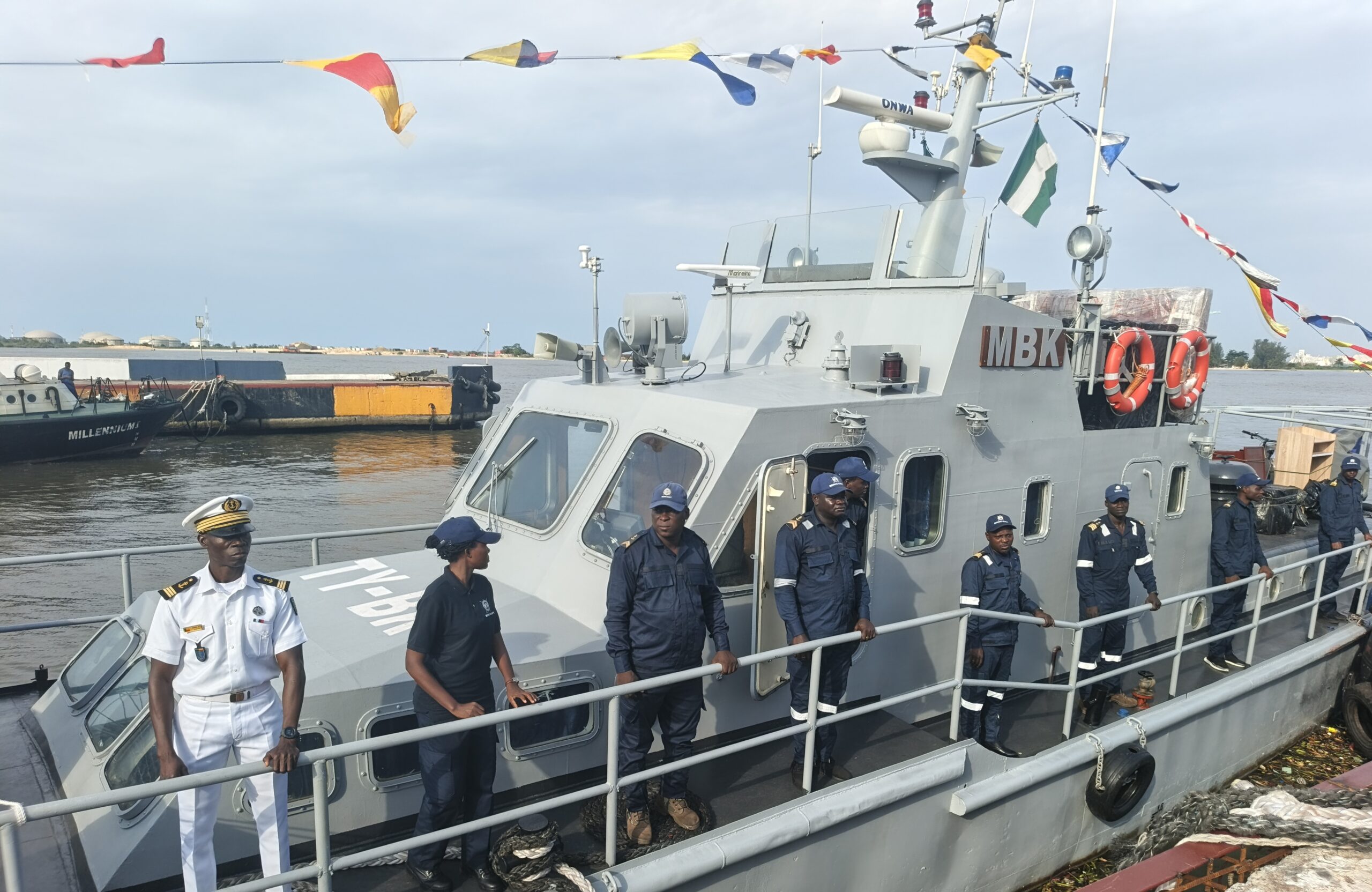
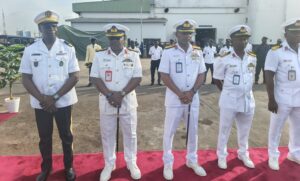
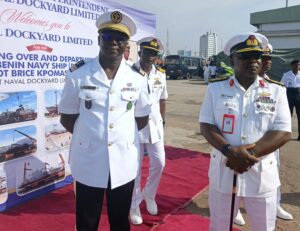
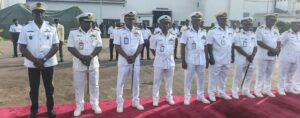
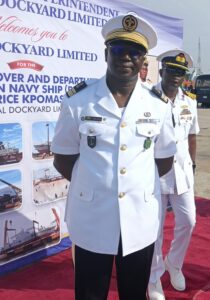
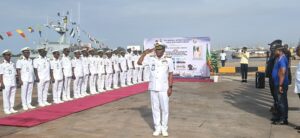
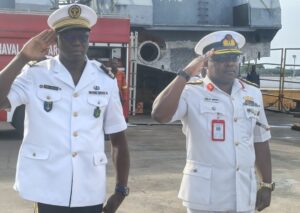
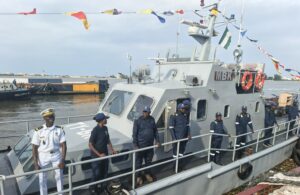
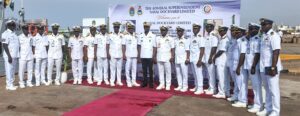
The Nigerian Navy, through its Naval Dockyard Limited (NDL), on Thursday formally handed over the refitted Benin Navy Ship (BNS) Matelot Brice Kpomassé to the Republic of Benin Navy. The event marked the successful completion of the vessel’s maiden docking and refit at the Naval Dockyard in Lagos, an achievement that underscores growing regional cooperation in maritime security and technical capacity development within the Gulf of Guinea.
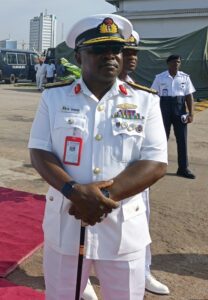
Speaking at the handover ceremony, the Admiral Superintendent, Naval Dockyard Limited, Rear Admiral Ibrahim Shehu, who represented the Chief of the Naval Staff, Vice Admiral Idi Abbas, emphasized that the project aligns with the objectives of the Yaoundé Architecture, a regional security framework designed to enhance collaboration among Gulf of Guinea nations in combating maritime threats.
“One of the key components of maritime security is the ability to deploy assets effectively for joint operations,” Rear Admiral Shehu stated. “Through the available capacity at the Naval Dockyard and under the guidance of our political and military leadership, including our Presidents and Service Chiefs, we have created an environment that ensures both Nigeria and the Republic of Benin have more operational vessels for shared patrols and enhanced maritime surveillance.”
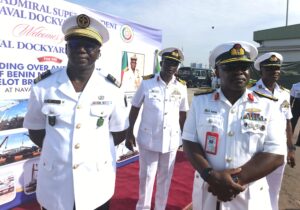
He noted that the ongoing collaboration between both navies was inspired by engagements under the Joint Maritime Command Centre (JMCC) based in Cotonou, which facilitates information sharing and operational coordination among member states.
“Maintenance of naval assets is a capital-intensive venture, which has posed challenges for some of our partners,” he explained. “However, with our proximity and established maintenance capacity, we have been able to provide technical support to the Benin Navy. This not only strengthens our partnership but also enables them to sustain their fleet at reduced cost.”
Rear Admiral Shehu disclosed that several Benin Navy vessels have now been successfully refitted by the Naval Dockyard, further cementing confidence in Nigeria’s growing maritime engineering expertise. Two additional ships under the same maintenance arrangement, he revealed, are expected to be ready for delivery within the next two to three weeks, subject to satisfactory sea trials.
“Our target is to complete the remaining three vessels before the end of this year or early next year,” he added. “The Benin Navy has expressed satisfaction with our work, and we are finalizing an annual maintenance agreement that reflects their trust in our technical capacity.”
He highlighted that the Dockyard’s operations conform strictly to international best practices and recognized classification standards governing marine engineering and ship maintenance.
“All our welders, mechanics, and technicians are certified and periodically evaluated to meet global requirements,” Rear Admiral Shehu noted. “Our collaboration with accredited classification societies ensures that every vessel leaving the Dockyard meets world-class safety and operational standards.”
The Admiral described the partnership as a practical model for regional self-reliance in ship maintenance, noting that previous reliance on distant foreign facilities often proved costly and inefficient.
“By working together as neighbours, we have found a faster, cheaper, and more effective solution for vessel upkeep and operational readiness,” he said.
Representing the Chief of Naval Staff of the Republic of Benin, Commodore Alexandre Hounkpatin, Captain Mohamed Idrissou, Director of Military Organisation and Personnel, commended the Nigerian Navy for its professionalism and continued support.
“Having a capable and reliable partner just two hours away from our base allows for rapid technical intervention and ensures our ships remain mission-ready,” Captain Idrissou remarked. “This cooperation is a remarkable achievement and a strong example of regional partnership in action.”
He stressed that maritime insecurity remains a shared challenge across the Gulf of Guinea, a region often described as one of the world’s most volatile maritime corridors.
“Whether or not that perception is entirely justified, the reality is that each nation must build its capacity to secure its waters and deter piracy,” he said. “No country should be the weak link in the Yaoundé Architecture’s security chain.”
Captain Idrissou revealed that Matelot Brice Kpomassé is the third Benin Navy vessel to undergo refit at the Naval Dockyard, with all three ships expected to resume round-the-clock coastal patrols upon their return.
“Our fleet comprises ships of varying technical origins, European and Chinese each with unique maintenance requirements,” he explained. “Previously, the lack of nearby facilities limited our ability to maintain them effectively. Now, with Nigeria’s Naval Dockyard, we have a dependable partner capable of delivering world-class maintenance services.”
He concluded by affirming Benin’s commitment to sustaining the partnership, describing it as essential for operational readiness and regional maritime safety.
Meanwhile, Rear Admiral Shehu disclosed that the success of the collaboration has attracted interest from other nations, including Equatorial Guinea, Congo, and Gabon, whose defense advisors have sought insights into the Nigeria–Benin model through the Defense Intelligence Agency.
“While no formal engagements have been concluded yet, discussions are ongoing,” he said. “We are optimistic that this cooperative approach will soon expand across the region, fostering stronger defense ties and a safer Gulf of Guinea.”