
Stakeholders in the maritime industry have expressed concern that despite Nigeria’s merchandise trade reaching $38.3 billion in 2025, the nation still lacks seagoing vessels flying its flag, leaving all international cargo carriage in the hands of foreign-owned ships.
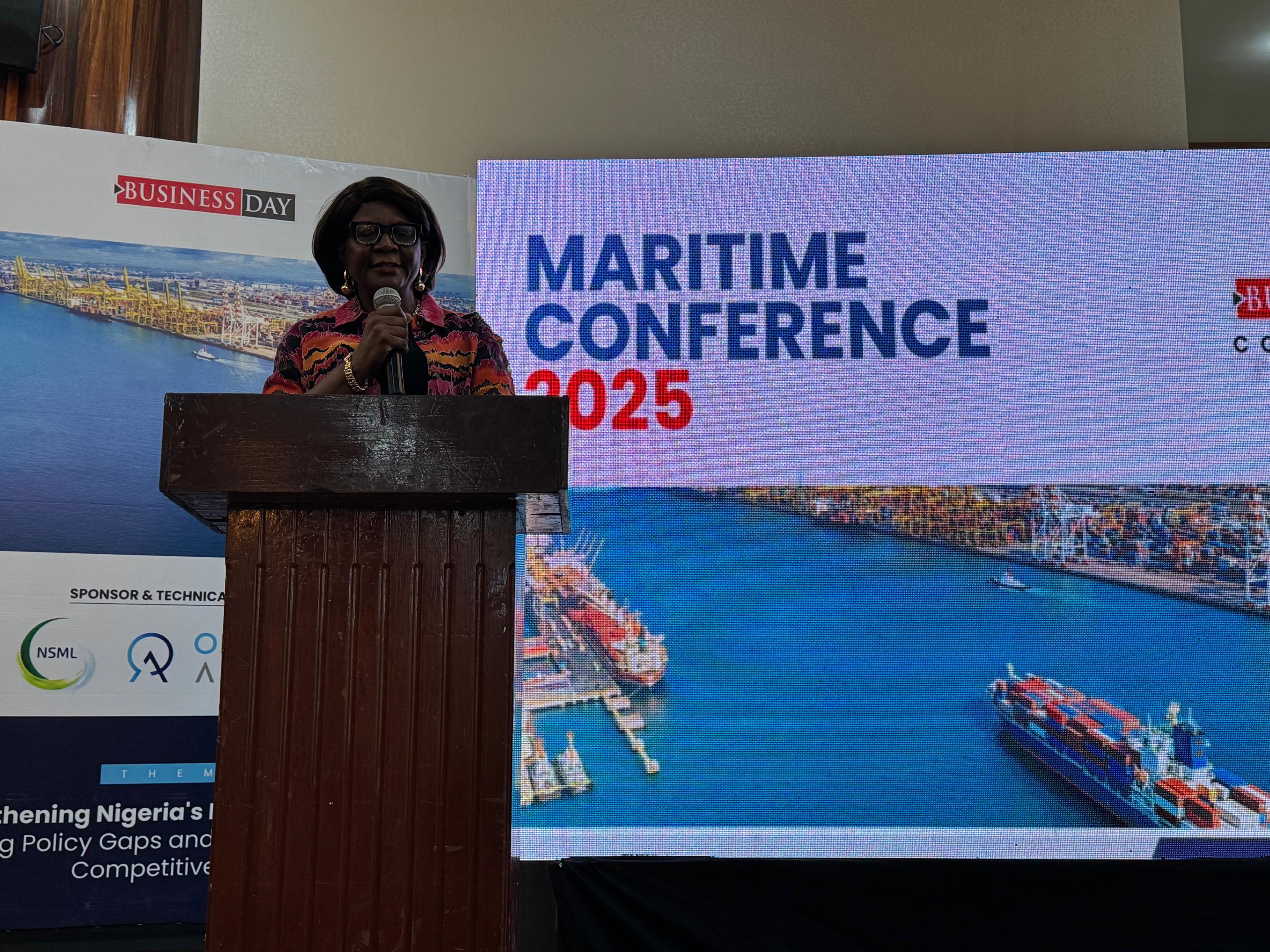
This concern was raised at the 2025 Maritime Conference organised by BusinessDay in Lagos, themed “Strengthening Nigeria’s Maritime Business: Bridging Policy Gaps and Optimizing Global Competitiveness.”
Delivering the keynote address, Barrister Mfon Usoro, National President of the Chartered Institute of Logistics & Transport (CILT) and former Director-General of the Nigerian Maritime Administration and Safety Agency (NIMASA), lamented Nigeria’s inability to translate its maritime potential into competitiveness.
Usoro disclosed that while crude oil trade accounted for $11.9 billion and non-crude trade $8.3 billion, no Nigerian-flagged vessel participated in carrying the cargo. She recalled that Nigeria once acquired 31 ships under the Obasanjo administration to boost indigenous fleet capacity, but poor planning, manpower gaps, and weak market studies led to their collapse.
“The market is there, but we are not participating. This is not a policy gap—it is an implementation gap. Owning a ship is not like buying a car; it requires structure, financing, and daily marketing assessment,” Usoro stressed.
She presented a maritime business schema anchored on five clusters—ship ownership and operation, ports and logistics, maritime technology, seafaring, and mining—arguing that Nigeria must prioritise ship ownership and coordinated planning across ministries of finance, petroleum, agriculture, mining, and trade to unlock competitiveness.
In his welcome address, Publisher of *BusinessDay*, Frank Aigbogun, said the maritime sector must be repositioned as the backbone of Nigeria’s trade, jobs, and growth. While acknowledging milestones such as the Lekki Deep Sea Port and investments by global operators like Maersk, he warned that infrastructure gaps, congested ports, and regulatory bottlenecks continue to stifle progress.
“Without serious investment in indigenous shipping, port modernization, and maritime skills, we risk missing the future,” he cautioned.
Also speaking, the Managing Director of NLNG Shipping and Marine Services Limited (NSML), Mr. Abdul-Kadir K. Ahmed, represented by Mr. Ladipo Egbeyemi, emphasized the importance of global standards and skill development. He revealed that NSML manages 13 vessels and has trained over 700 Nigerian seafarers through its Maritime Centre of Excellence.
From the subnational level, Anambra State Commissioner for Transportation, Mrs. Patricia Igwebuike, called for the revival of Onitsha River Port, stressing its strategic importance in easing pressure on road infrastructure across Southern Nigeria.
Meanwhile, Chief Tochukwu Ezisi, National President of the National Association of Government Approved Freight Forwarders (NAGAFF), represented by General Secretary Chief Godfrey Nwosu, urged digital transformation and ethical reforms in maritime logistics to drive inclusive growth.
The conference, attended by policymakers, investors, regulators, and operators, was widely described as a timely forum to address Nigeria’s long-standing maritime challenges and chart a path toward global competitiveness.