
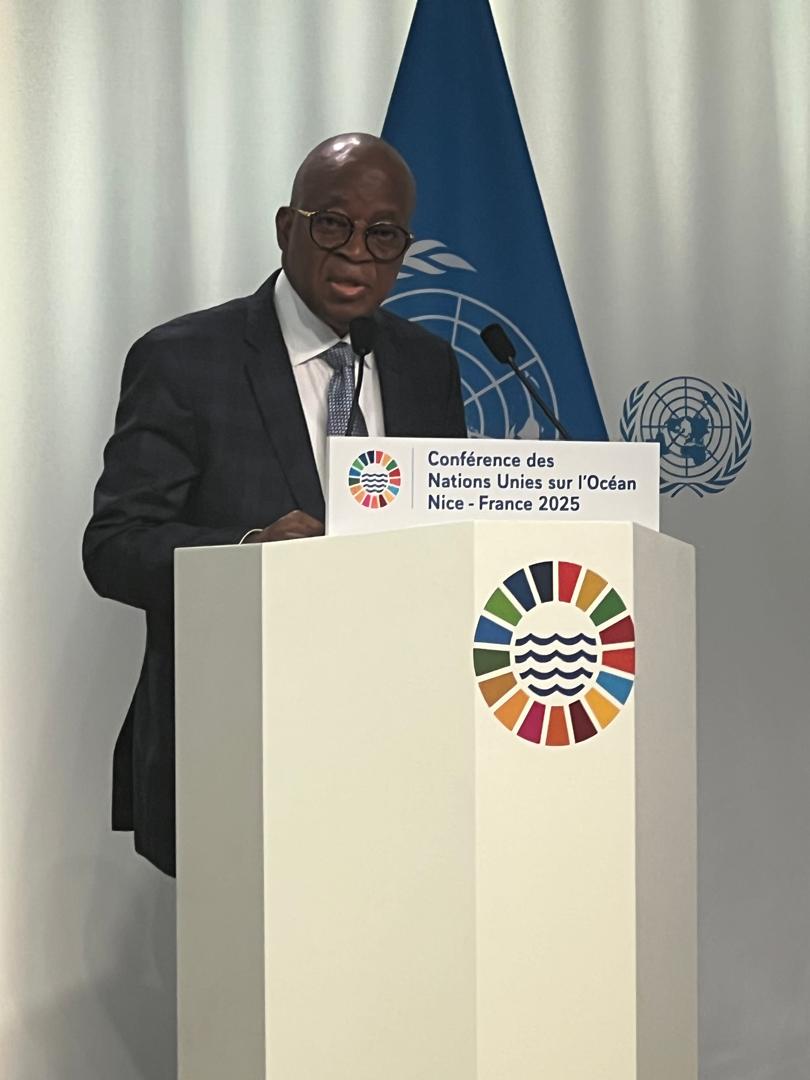
Nigeria has called for the immediate ratification of the Biodiversity Beyond National Jurisdiction (BBNJ) Agreement and an urgent increase in blue economy funding for developing nations at the ongoing United Nations Ocean Conference in Nice, France.
Delivering Nigeria’s national statement on behalf of President Bola Ahmed Tinubu, the Minister of Marine and Blue Economy, Adegboyega Oyetola, CON, emphasized the need for bold, collective global action to safeguard the world’s oceans for future generations. The high-level conference, co-hosted by France and Costa Rica, has drawn participation from over 120 countries under the theme *“Accelerating Action and Mobilising All Actors to Conserve and Sustainably Use the Ocean.”*
Minister Oyetola affirmed Nigeria’s deep commitment to ocean sustainability, noting that as a coastal state, the country views the ocean as a source of natural wealth, food security, employment, and sustainable livelihoods.
He announced that Nigeria has already signed the BBNJ Agreement and is progressing with its ratification. He stressed the importance of designating at least 30 percent of the global ocean as Marine Protected Areas by 2030 to meet Sustainable Development Goal (SDG) 14. However, he cautioned that this vision requires robust international monitoring and enforcement frameworks.
“As a responsible member of the global community, Nigeria remains committed to the goals of SDG 14, the African Union Agenda 2063, and the Kunming-Montreal Global Biodiversity Framework,” he said.
Demonstrating regional leadership, Oyetola disclosed that Nigeria had led efforts among West African nations to develop a proposal for a High Seas Marine Protected Area in the Convergence Zone of the Canary and Guinea Currents.
Backing the draft *Nice Ocean Action Declaration and Plan*, Nigeria called on international investors and development partners to provide both financial support and technical assistance to help developing countries implement ocean-based initiatives effectively.
“Nigeria believes meaningful contributions in blue finance and marine science are critical to enabling better policy decisions and promoting sustainable ocean sectors,” Oyetola added.
He also outlined several national initiatives aimed at improving ocean governance in Nigeria, including:
* The adoption of a National Blue Economy Policy to encourage sustainable ocean-based industries;
* A roadmap for BBNJ treaty ratification and implementation;
* The revision of Nigeria’s National Biodiversity Strategy and Action Plan;
* A National Policy on Marine Plastic Pollution to tackle marine debris;
* And the advancement of hydrographic surveys and modern charting for safer navigation across Nigerian waters.
He also reaffirmed Nigeria’s resolve to combat transboundary ocean challenges such as illegal, unreported, and unregulated fishing, marine dumping, and weak ocean monitoring systems.
Minister Oyetola concluded by calling on all nations to take urgent and decisive steps to ratify the BBNJ Agreement and scale up support for blue economy programs, stating that “political will, scientific innovation, and global cooperation” are essential to protect ocean health.
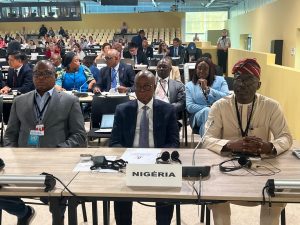
Nigeria’s delegation to the conference includes top officials such as the Permanent Secretary of the Federal Ministry of Marine and Blue Economy, Mr. Olufemi Oloruntola; the Director-General of NIMASA, Dr. Dayo Mobereola; NIWA MD, Asiwaju Bola Oyebamiji; Director of Maritime Safety and Security, Mr. Babatunde Bombata; and Director of Fisheries, Mr. Wellington Omoragbon.
The urgency of Nigeria’s call was echoed by United Nations Secretary-General António Guterres, who warned that the oceans are under unprecedented stress due to overfishing, rising temperatures, acidification, and plastic pollution.