
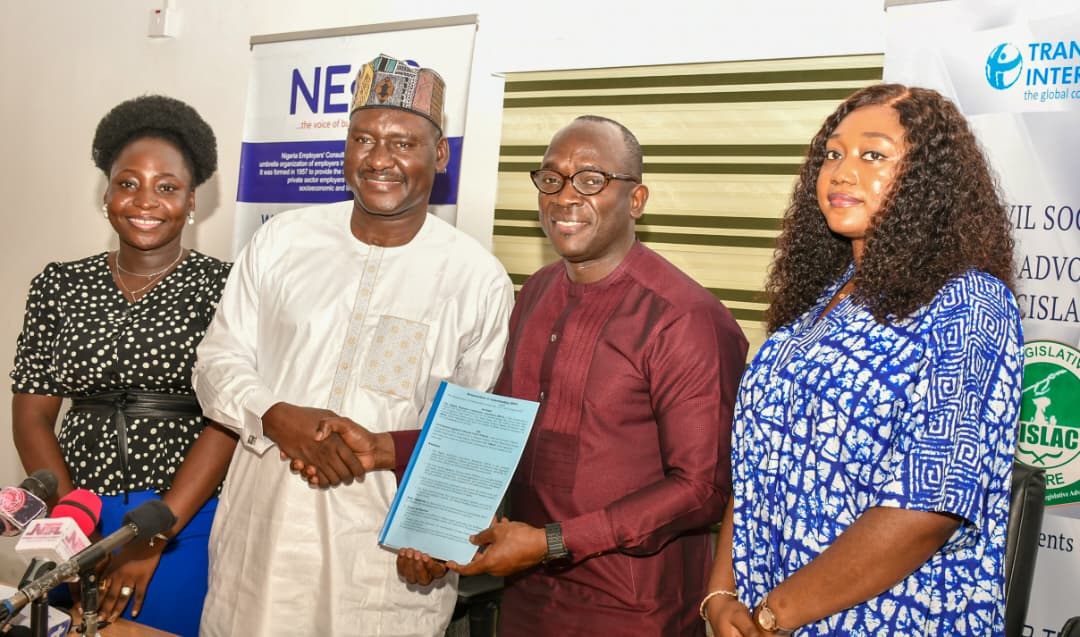
The Nigeria Employers’ Consultative Association (NECA) and the Civil Society Legislative Advocacy Centre (CISLAC) have signed a Memorandum of Understanding (MoU) aimed at enhancing workers’ welfare and strengthening business sustainability in Nigeria.
Speaking during the signing ceremony on Tuesday in Abuja, NECA’s Director-General, Mr. Adewale-Smatt Oyerinde, described the agreement as a significant step forward uniting the voice of organised business with civil society’s role in promoting accountability and good governance.
“This MoU represents more than a formal agreement it’s a shared commitment to addressing Nigeria’s economic and governance challenges through collaboration,” Oyerinde said.
He highlighted NECA’s longstanding mission to support enterprise growth, promote decent work, and advocate for a business friendly environment. He praised CISLAC for its dedication to transparency, accountability, and civil rights.
“Together, we will be a more powerful voice for Nigeria’s economic and social transformation,” he added.
Oyerinde noted that the partnership will focus on advancing policy reform, promoting fair taxation, responsible business practices, gender equity, climate action, and eliminating barriers to job creation and business growth.
Commending CISLAC’s advocacy efforts, he emphasized the shared goals of businesses and citizens in pursuing transparency, fairness, and stability.
Also speaking at the event, CISLAC’s Executive Director, Mr. Auwal Rafsanjani, described the partnership as a “covenant of trust” among civil society, employers, and the workforce.
He stressed that labour should not be commodified, but treated with dignity through fair wages, safe work environments, and respect.
“Undervaluing workers only weakens national productivity and prosperity,” Rafsanjani said.
He outlined key objectives of the collaboration, including evidence based policy advocacy, improved labour rights, equitable governance, public health, and climate action.
“We will hold authorities accountable, engage with the private sector, and strive for a Nigeria where the dignity of labour and justice in governance are protected,” he stated.
Rafsanjani also raised concerns over the rise in underemployment and informal labour, calling for greater investment in education, skills development, and fair workplace policies to reverse the trend.