
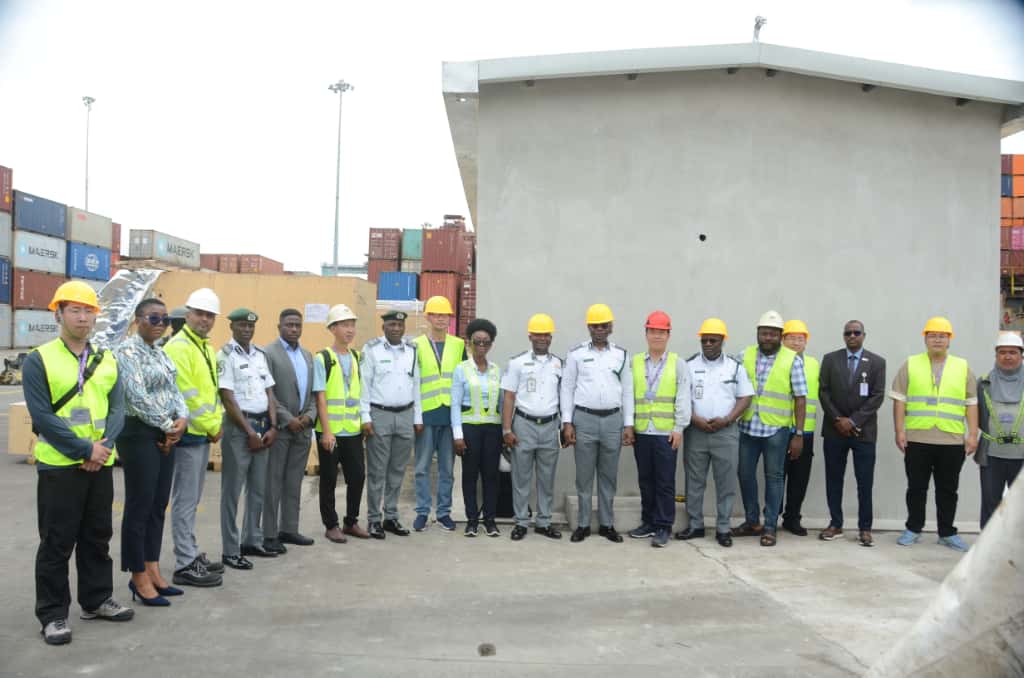
The Apapa Command of the Nigeria Customs Service (NCS) has assured port stakeholders of a more seamless trade process with the commencement of fixed scanners installation, expected to boost efficiency and enhance cargo examination at the nation’s busiest port.
Customs Area Controller (CAC) of the Command, Comptroller Oluwadare Oshoba, gave the assurance shortly after inspecting the site designated for the installation of three state-of-the-art scanners. According to him, the equipment will enable the Command to examine up to 200 containers per hour, a development he described as “a milestone in Nigeria’s customs modernisation drive.”
“The scanners will be strategically located at the quayside, close to the berthing area. This operational masterstroke will ensure that no consignment escapes high-tech, non-intrusive inspection at Apapa Port,” Oshoba said.
He commended the Comptroller-General of Customs, Bashir Adewale Adeniyi, for championing the Service’s modernisation project and urged officers to prepare for intensive training sessions ahead of the scanners’ full deployment. He also charged ICT officers to strengthen their technical capacity for maintenance at different levels, stressing that the technology is the first of its kind in West and Central Africa.
While cautioning importers and agents to embrace honest declarations, Oshoba noted that concealments and false documentation would be easily exposed by the scanners. “This is one of the many fruits of the modernisation project that will save time, increase revenue, enhance national security, and curb port-related crimes from the point of entry,” he added.
On the technical specifications, Aliyu Suleiman, Team Leader of the Trade Modernisation Project (TMP), explained that the scanners, produced by Nuctech in China, are the FS6000 model, a high-throughput, non-intrusive, drive-through X-ray system. Capable of inspecting containers and trucks in a single pass at speeds up to 15 km/h, the system also integrates with advanced features such as License Plate Recognition (LPR) and Radio Frequency Identification (RFID).
Suleiman disclosed that the installation would take 45 days and assured that the design allows for flexibility, relocation, and integration with other security systems. In addition, APM Terminals has pledged to provide one of the scanners and a mobile unit as backup to prevent downtime.
The deployment of the scanners is expected to reinforce Apapa Port’s status as Nigeria’s leading maritime trade hub while advancing the federal government’s trade facilitation agenda.